Ho Chi Minh City, Vietnam: High-Energy Value Play
Ho Chi Minh City: A Fast-Paced Value Play
Ho Chi Minh City (Saigon) is Vietnam’s economic engine – a high-energy metropolis boasting world-class street food, modern malls, and millions of motorbikes. It’s also one of Southeast Asia’s cheapest major cities for expats: guides estimate a comfortable monthly budget around $800–1,400 per person (expatlife.ai) (www.yournewbase.com). Recent data for digital nomads put it in the $1,000–1,500 range (getwherenext.com). Yet HCMC’s blend of searing traffic and bureaucratic quirks poses real dealbreakers for some. Below we break down the essentials – safety, living costs, visa/tax rules, healthcare, climate, infrastructure and cultural surprises – and compare HCMC to Bangkok and Manila to give a clear, data-driven picture of life here.
Safety by District
Overall Vietnam is very safe by regional standards (grokipedia.com). Violent crime is low, but you must watch out for petty theft and roadside snatchings, especially in tourist zones. Even in District 1 (the downtown/tourist core) crime is mostly opportunistic – pickpocketing, phone-snatching on scooters and occasional scams (housingvietnam.com). HousingVietnam (a local real-estate site) rates District 1 only 3.5/5 on safety, noting that D1’s night bazaars and backpacker streets require vigilance (housingvietnam.com). By contrast, affluent expat suburbs are much safer. District 2 (Thảo Điền/Mỹ Thạnh) – with its gated compounds and riverside parks – is rated roughly 4.5/5, with only rare snatch attempts on busy roads (housingvietnam.com) (housingvietnam.com). District 7 (Phú Mỹ Hưng) is about 4.8/5, thanks to wide roads and private security; crime there is mostly limited to isolated thefts in the older Vietnamese quarters (housingvietnam.com). In practice, most expats feel quite secure in D2 or D7, whereas in D1 one keeps one’s belongings close and avoids dark side-streets at night. (Local travel advisories and surveys consistently list Vietnam as one of Southeast Asia’s safest countries for foreigners (grokipedia.com).)
Rent Trends and Cost of Living
Real estate data show rentals rising fast after the pandemic. In 2024 the online platform Nhà Tốt reported average apartment rents up 4–40% year-on-year across many districts (vnexpress.net). For example, Thu Duc City’s average 1-bedroom rent jumped ~12% from mid-2023 to mid-2024, while District 4 and Phú Nhuận saw 17–28% increases (vnexpress.net). A local broker notes mid-market apartments are about 10–15% higher than a year before (vnexpress.net). Strong expat demand and a limited supply keep pushing prices up, especially for new or high-end units.
Despite these increases, HCMC remains near the bottom for big-city housing costs in Asia. Expats typically budget $500–900/month for a one-bedroom city-center flat (expatlife.ai). Total monthly living costs (rent plus food, transport, etc.) are often cited in the $800–1,400 range for a single person (expatlife.ai) (www.yournewbase.com). For comparison, Bangkok is noticeably pricier: a recent comparison puts Bangkok’s average solo budget at ~$1,027 vs $762 in HCMC (livingcost.org). Manila is also higher – Expatistan finds HCMC ~14% cheaper than Manila overall (livingcost.org). Food, transit and services in HCMC are very cheap by Western standards, with street meals for ~$1–2 and motorbike taxis at a few cents per km. Western-style fare or imported products cost more but still beat US/Europe prices.
Visas, Long Stays, and Taxes
Vietnam does not currently have a dedicated “digital nomad” visa (getwherenext.com). The most common route is the 90-day e-visa. As of July 2023, Vietnam extended its e-visa model from 30 to 90 days (multiple entry) (getwherenext.com) (baochinhphu.vn). Foreigners can apply online, pay about $25, and after approval may enter Vietnam and exit/re-enter freely during the 90-day term (baochinhphu.vn). Tourist visas (typically 30 days with one or two extensions) are also available, but the new 90-day e-visa makes long visits simpler. Note however that the e-visa cannot be extended while in-country (nomados.ai) – holders must either exit and reapply or use a visa agency to obtain a fresh stamp (or switch to a business visa).
Many nomads solve this by alternating visa-renewal trips to neighboring countries. A business visa (DN visa) can be arranged via a sponsoring company and lasts 3–12 months with multiple entries (nomados.ai). But realistically, most remote workers on short stays just rely on back-to-back tourist/e-visas. In any case, do not plan to work for a Vietnamese company without a proper work permit – this is illegal on a tourist or business visa. (Most digital nomads avoid this by working for firms abroad; in practice remote work for foreign clients is quietly tolerated on a tourist visa (nomados.ai), but it remains officially forbidden.)
Taxation is straightforward for nomads. Vietnam uses a 183-day rule. Anyone spending under 183 days/year (and no permanent Vietnamese address) is a non-resident for tax purposes. Non-residents pay a flat 20% on Vietnam-sourced income only (getwherenext.com). Since most nomads earn from overseas clients, that means essentially zero Vietnamese tax liability for stays under 183 days (getwherenext.com). In other words, unless you earn Vietnamese salary, you owe no income tax locally. Only if you stay 183+ days or formally register residency do you become subject to Vietnamese income tax on worldwide earnings at progressive rates (up to 35% top rate (getwherenext.com)). So for short-term expats the tax situation is very simple.
Healthcare
HCMC’s healthcare scene is much better than in most of Vietnam, though it still lags regional hubs. The city has multiple JCI-accredited international hospitals and clinics. Institutions like FV Hospital (French-Vietnamese), City International (American-Vietnamese) and Columbia Asia are staffed with English-speaking doctors often trained in the US, Japan, Europe etc (expatarrivals.com) (www.expatarrivals.com). They offer modern facilities and accept major international insurance plans. General practice and basic emergency care at these private hospitals are excellent by Asian standards (expatarrivals.com), and medical tourism to HCMC is growing. However, for very specialized or surgical care many expats still travel to Bangkok or Singapore. (Expats repeatedly report that for anything serious they prefer regional medical centers despite HCMC’s improvements (www.expatarrivals.com).) A strong recommendation is to carry comprehensive international health insurance with evacuation coverage.
Climate, Pollution and Internet
Ho Chi Minh City has a tropical monsoon climate. It is hot and humid year-round (average highs ~31°C), with a distinct dry season (December–March) and a wet season (May–October). Rainy-season afternoons bring heavy downpours and occasional flooding in low-lying areas. If you dislike humidity and rain, plan around the November–March window. Air quality is better than in land-locked Hanoi but still unpredictable. Traffic emissions and seasonal crop burning can push PM2.5 into “moderate” or “unhealthy” levels at times, so sensitive individuals take precautions.
On the plus side, HCMC has excellent internet infrastructure. Fiber-optic broadband is widespread in expat districts, routinely delivering 90–160 Mbps speeds at home (www.yournewbase.com). Even mobile 4G/5G often exceeds 100 Mbps. This makes the city very attractive for remote workers and digital nomads; cafés and co-working spaces have fast Wi-Fi. In benchmark tests Ho Chi Minh’s internet speeds generally rival Bangkok’s and far surpass Manila’s average.
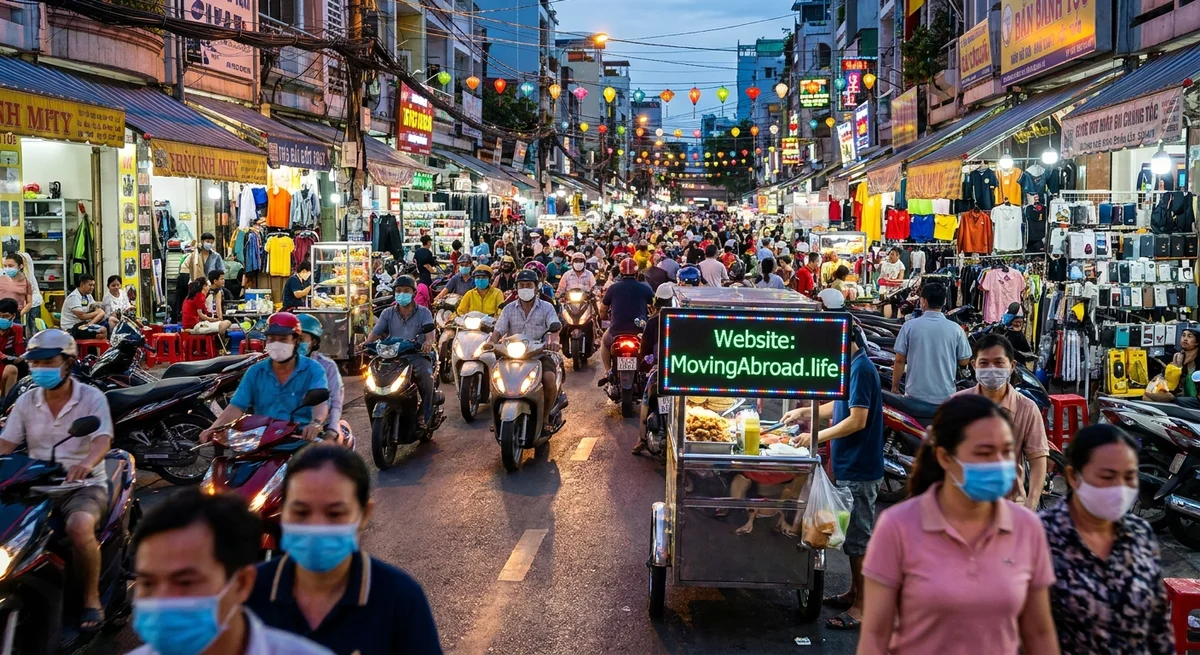
Motorbike Culture. If there is a single image of HCMC, it’s the sea of scooters. The metro area counts 7+ million motorbikes (www.yournewbase.com). Riding a bike is by far the most common way locals commute. Intersections swarm with riders any time of day, and traffic never really stops – even red lights. Foreigners should be very cautious: crossing streets requires weaving through motorbikes which assume right-of-way. Many expats eventually hire a driver or use Grab (ride-hailing) cars motorbikes for safety. But riding a bike yourself is doable (and cheap) if you take time to adapt. The key is slowly letting waves of bikes pass around you and trusting that drivers will avoid you.
Dealbreakers & Comparisons
Traffic. The intensity of HCMC traffic rivals Bangkok’s chronic congestion and is often worse than Manila’s gridlock. Daily commutes can be long even for short distances. While the upcoming metro lines will help, for now everyone copes by planning extra travel time, using motorbike taxis (GrabBike), or moving closer to work. This chaotic pace can be a daily stressor for newcomers.
Language and Bureaucracy. Vietnamese is a tonal language with a complex alphabet; outside expat bubbles (and major businesses) English is limited. This poses a real barrier in bureaucracy and daily life. All official paperwork – visa extensions, workplace permits, rental contracts, banking – is conducted in Vietnamese. Expats often rely on translators or fixers. Visa/permit processes in particular can be slow and opaque (expatlife.ai). Many rules change with little public notice. For instance, foreign residents now frequently report that banks require proof of local residency or work permits before allowing account opening (expatoo.com). (A local April 2024 guide warned that post-2023 anti-money laundering rules mean almost every major Vietnamese bank asks for a valid work visa and local address to open an account (expatoo.com).) Even paying utilities or using mobile apps often demands a local SIM or residency card. In this respect HCMC trails Manila (where almost everyone speaks English) and Bangkok (where bureaucracy is comparatively more Anglophone).
Banking and Visa Rules. Closely related is the fact that banking and visa regulations are in flux. The government frequently tweaks visa categories, stamping policies and banking limits. For example, in mid-2023 Vietnam passed laws extending the e-visa to 90 days (baochinhphu.vn) and expanded entry points for e-visas. But there is no formal digital-nomad visa, so rules on extensions or multi-entry can still change on short notice. As one guide notes, the absence of a fixed digital-nomad category means nomads must “get creative” with business visas and border runs (nomados.ai) (expatlife.ai). Banking is similarly hands-on: card payments are accepted, but transferring large sums or holding foreign currency on deposit can require extra approvals. In short, you should assume some paperwork hassles when moving funds or visas, much more so than in Manila or Bangkok.
Benchmarking vs Bangkok and Manila: In broad terms, HCMC’s profile is similar to Bangkok or Manila in some ways – chaotic traffic, motorbike noise, humid heat – but with key differences. Costs in HCMC are generally lower. As noted, a solo expat’s living cost in Bangkok is roughly 25% higher than in HCMC (livingcost.org), and Manila’s costs are also above HCMC by about 10–15% (livingcost.org) (livingcost.org). Safety-wise, Vietnam (including HCMC) is ranked much higher in Southeast Asia (low violent crime) than either Thailand or the Philippines (grokipedia.com). Culturally, HCMC is a true Asian melting pot: much like Bangkok, it offers international restaurants and nightlife, though Bangkok’s tourism infrastructure is more polished. Manila’s entertainment is popular but often more expensive and sprawled. Health care quality in HCMC stands above Manila’s generally poor public system, and is on par with Bangkok’s – though for specialized care most expats still fly to Bangkok or Singapore as needed (www.expatarrivals.com). All three cities have world-class cuisine, but HCMC’s is famous for street food affordability.
Conclusion
Ho Chi Minh City packs enormous energy and value. It scores highly on things nomads love – fast internet, great food, low living costs, and a lively expat scene – but can be frustrating in traffic and red tape. By district, young professionals and single nomads often settle in District 1 or 4 to feel the buzz (at higher rent), while families and longer-term residents favor D2 or D7 for the quieter, safer vibe. The visa situation requires flexibility (no true “nomad visa” yet), and banking/language issues mean plan for helpers or translators. In a word: HCMC is a “value play” – if you crave affordability and excitement and can tolerate chaos and bureaucracy, it delivers. But if jammed streets and Vietnamese-only paperwork are dealbreakers, one might lean more toward places like Bangkok (better English/banking) or Chiang Mai (less traffic) as alternatives.
Get New Relocation Research & Podcast Episodes
Subscribe to receive new research updates and podcast episodes about moving abroad, best places to live, expat life, remote work destinations, retirement abroad, cost of living, visas, safety, healthcare, and quality of life.