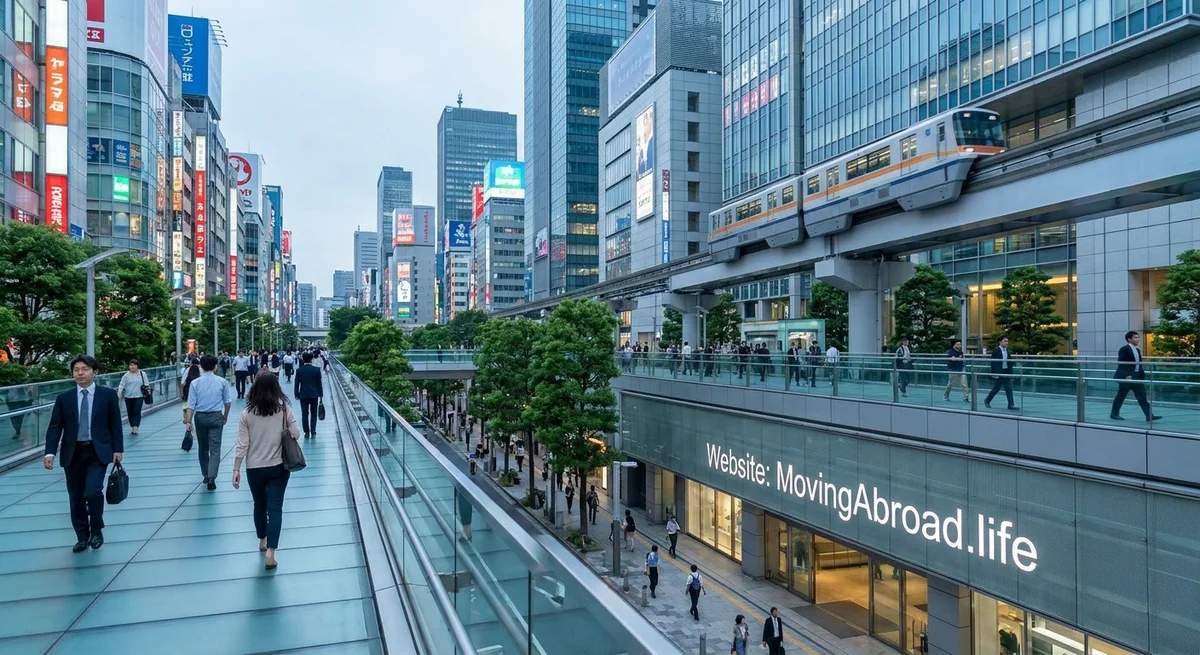
Tokyo, Japan: Ultra-Safe Megacity for the Determined
Tokyo, Japan: Ultra-Safe Megacity for the Determined
Tokyo is consistently ranked one of the world’s safest major cities (impact.economist.com). Violent crime is extremely rare here, and even petty thefts are uncommon. Tokyo’s building codes and urban planning emphasize earthquake resilience and public safety. In fact, among Tokyo’s 23 wards, Setagaya (世田谷区) and Koto (江東区) rank among the safest, placing 3rd and 4th (lowest crime rate) in the city (www.anzen-map.jp). As a result, Tokyo’s residents – locals and expats alike – enjoy walking home at night and living in densely populated neighborhoods without the fear common to many large cities. Drug use and gun violence are virtually nonexistent, and public order is meticulously maintained. (By contrast, expatriates in Seoul or Taipei experience safe cities as well, but Tokyo’s crime rates are exceptionally low even by their standards.)
Cost of Living and Housing
Housing rents: Tokyo’s living costs are high, especially in popular wards. For example, central wards like Meguro average around ¥225,000 per month in rent (realestate.yahoo.co.jp), whereas more residential areas like Setagaya average about ¥173,000 (www.anzen-map.jp) and Koto about ¥169,000 (www.anzen-map.jp). XROSS HOUSE (a Tokyo apartment broker) notes that a furnished 1R/1K studio in Setagaya typically rents for ¥70,000–¥100,000 (x-house.co.jp), while a 1DK/1LDK is ~¥100,000–¥180,000 (x-house.co.jp). By contrast, a similar 1-room in Meguro is more like ¥120–¥150K. These rents exclude utilities, which can add another ¥10K–¥15K monthly (electricity, gas, water, internet). In suburban wards (like northern Setagaya or farther-out Koto) rents skew toward the lower end of these ranges; near Shibuya or Tokyo Station (e.g. Meguro or central Koto), rents hit the high end.
Other living costs: Tokyo dining and groceries are also pricey. A casual lunch costs on the order of ¥900–¥1,000 ($7–8) (livingcost.org), and a restaurant dinner for two can be ~$42 (livingcost.org). Monthly food and household expenses might reach $400–$450 per person (livingcost.org). Public transport is efficient but not cheap: a commuter pass is roughly $75–$80/month (livingcost.org) (¥8,000–¥9,000). Utilities run ~$100–$150 for a couple (electric/gas/water combined (livingcost.org)); high-speed internet is about $30/month (livingcost.org). In summary, conservative estimates peg a single adult’s monthly budget (including rent) around ¥200–250K ($1,500–$1,800) (livingcost.org). A family of four typically needs on the order of ¥600–700K per month (livingcost.org). These figures line up with cost-of-living databases – for example, one site finds $1,700 (¥280K) for one person with rent, and $4,100 (¥685K) for a family of four (livingcost.org).
Sample budgets: As a rule of thumb, a single expat should expect to spend ¥200K+ monthly to live comfortably in Tokyo. A dual-income couple might safely budget ¥300–400K (one should cover rent and taxes, the other handles living costs). A family (two adults plus children) will often spend ¥500–700K on rent, food, schools, etc. (Private school is the biggest wild card – see below.) Even a modest budget can be managed: the share-house market even advertises rooms from ¥35K–¥48K per month (all-inclusive and with no key money or deposit) (x-house.co.jp). Note that Tokyo’s average after-tax income (¥370K/month (livingcost.org)) generally covers these needs; nevertheless, living here is font of constant trade-offs (e.g. smaller apartments or cheaper neighborhoods if costs pinch).
Deposits and key money: Foreigners must remember Japanese rental customs: most leases require a refundable security deposit plus a non-refundable key money (礼金). This “gift” to the landlord typically equals 1–2 months’ rent, effectively doubling the move-in cost. Additionally, landlords usually demand a Japanese guarantor. (Many expat specialists therefore recommend using guarantor services or international-friendly rentals to avoid these hurdles.) In contrast, Seoul and Taipei generally lack the key-money tradition (tenants usually pay only first/last months as deposit) and have more English-friendly leasing paperwork.
Visas and Work Permits
Standard work visas: To work in Japan you generally need a sponsored visa from a Japanese employer. The most common category is the Engineer/Specialist in Humanities/International Services visa (www.saiyouteam.com). It covers university-educated professionals working in tech, finance, design, marketing, teaching (non-careers), etc. To qualify, your job duties must closely match your academic background, and you need a degree (or equivalent experience) (www.saiyouteam.com). Aside from that, salary and employer size matter: Japan expects foreign specialists to earn a competitive wage (roughly parity to a Japanese peer) to be eligible (www.saiyouteam.com). Once in the country, these visas need regular renewal (typically 1–5 years).
Highly Skilled Professional visa: Japan also offers a prized “Highly Skilled Foreign Professional” visa (ポイント制高度人材 in Japanese). This points-based category is time-limited but comes with perks (faster path to permanent residency, longer stays, family advantages, etc.). To qualify, you must first fit one of the advanced work categories (e.g. researcher, engineer, manager) and score at least 70 points on a government scale (points are awarded for high qualifications, salary, experience, advanced degrees, etc.) (ligareus.com). For example, a master’s or doctorate, a tech job, and a high salary will boost your score. Achieving HSP status generally requires a very strong profile, but it grants multiple years (and eventually no-limit renewals). (By contrast, neither Seoul nor Taipei has an exact equivalent points-based visa; South Korea mostly issues fixed-term student/work visas, and Taiwan offers an entrepreneur visa but without a broad fast-track program like Japan’s HSP.)
Startup and investor visas: Japan has introduced special pathways for entrepreneurs. In Tokyo, a Startup Visa program lets foreign founders spend one year in Japan on a “Designated Activities (Special Activities)” visa to prepare their business (www.investtokyo.metro.tokyo.lg.jp). Practically, you must present a recognized business plan (in approved fields) to Tokyo authorities, who then pre-approve your application so you can land with this one-year startup visa. This period is meant for setting up office, raising funds, etc., before switching to a full Business/Management visa (経営・管理). It’s worth noting that Japan’s Business visa requirements have become very strict: starting late 2025, an entrepreneur must have at least ¥30 million capital and hire one full-time local staff (on top of other criteria) (workingvisa.csap.tokyo). In sum, Tokyo’s startup program offers a bridge into Japan, but scaling beyond that requires meeting stiff Business Manager conditions.
Healthcare and National Insurance
Japan has universal medical insurance – every resident (including foreigners) must enroll. If you work for a company, you typically join your employer’s plan. If not, you sign up for National Health Insurance (Kokumin Kenko Hoken) at your city/ward office within 14 days of arriving or leaving employment (e-zeirishi.com). Premiums are income-based. For example, someone earning ¥4 million annually will pay roughly ¥400,000/year (or about ¥34K/month) for NHI (e-zeirishi.com). When receiving care under the system, patients pay only 30% of medical costs out-of-pocket (the insurance covers 70%) (e-zeirishi.com). This applies to doctors’ visits, hospital stays, and most treatments. (Dental and vision are partially covered too, and each prefecture caps premiums to some degree.)
The quality of healthcare in Tokyo is excellent. International hospitals and major clinics are well-staffed, many doctors speak some English, and wait times are usually short. Still, navigating the system requires paperwork in Japanese. In comparison, South Korea and Taiwan have similarly strong insurance: Korea’s National Health Insurance also covers 60–70% of costs, and Taiwan’s covers essential care. But Japan’s system is among the most comprehensive globally, with extremely high life expectancy reflected in OECD reports.
Taxes and Finances
Tax rates in Japan are progressive. National income tax starts at 5% on low incomes and rises to 45% on the highest brackets (taxsummaries.pwc.com). For example, taxable income over ¥40 million is taxed at 45% (plus a 2.1% “reconstruction surtax”) (taxsummaries.pwc.com). On top of that, local inhabitant taxes (prefectural + municipal) add about 10% of your income each year. So effectively, high earners pay roughly half their income in combined taxes. In addition, Japan’s consumption tax (sales tax) is a flat 10% on most goods and services. These rates mean Tokyo is not a tax haven – but it’s comparable to other wealthy cities. Notably, Tokyo does not have wealth or capital gains taxes beyond corporate rates, and foreign-source income is generally exempt unless you live here long-term. Expats should do tax planning, especially if they have overseas income (Seoul taxes worldwide income only for permanent residents, Taipei for citizens).
Earthquakes and Disaster Preparedness
Tokyo is on the other side of the Pacific Ring of Fire, so seismic activity is a fact of life. History warns that large quakes (magnitude 7–8) could strike the region every few decades (www.jishin.go.jp). The city is well-prepared. Japan’s building codes (overhauled after the 1995 Kobe quake and again in 1981) ensure nearly all buildings and infrastructure can survive major tremors. Houses and skyscrapers use advanced dampers and flexible designs. Frequent drills are held (with schoolchildren and office workers), and an emergency alert (J-Alert) system sends real-time quake warnings and evacuation instructions to phones and loudspeakers. Sewage and gas lines have automatic shut-offs, fire departments train for mass response, and every ward publishes hazard maps.
Tokyo also plans for other disasters: tsunami risk is low in the city center (far from the coast), but floods and typhoons are addressed with hardened infrastructure (levees, drainage). Neighborhood evacuation areas and shelters are well-signposted. Overall, while no city is quake-proof, Tokyo’s disaster readiness is among the world’s best. (For comparison, Taipei – also on an active fault line – has a similar culture of preparedness, while Seoul has much lower quake risk.)
Transportation: World-Class Transit
Tokyo’s transit network is legendary. Over a dozen rail operators (Tokyo Metro, Toei, JR, plus private lines) interlock to cover almost every neighborhood. Trains and subways run often (every 2–5 minutes in rush hour) and very punctually (delays are usually seconds!). A Tokyo transit card (Suica/Pasmo) works on all trains, buses, and even taxis, making travel seamless. A typical one-way subway fare is ¥200–300. A monthly metro pass runs about ¥8–¥9K (livingcost.org). Taxis are relatively affordable by international standards (¥700 base, then ~¥300 per km) and ubiquitous, though traffic can be heavy.
Inter-city transport is equally impressive. Tokyo terminals (Tokyo, Shinagawa) connect via shinkansen bullet trains to the rest of Japan. For air travel, two major airports serve Tokyo: Haneda (closer for domestic/Asia) and Narita (for long-haul international flights). Both are large international hubs with modern facilities. Overall, getting around Tokyo (and beyond) is safe, reliable, and convenient – a definite plus for newcomers.
Schools and Education
Families should note that public schools in Tokyo are Japanese-medium. Local elementary and secondary schools are excellent, but classes are almost entirely in Japanese and geared to national exams. Foreign children can attend with permission, but without Japanese fluency they often struggle. Many expat families therefore choose private international schools. Tokyo has dozens of these (British, American, IB, and country-specific curricula). They come at a premium: annual tuition typically ranges from about ¥1.2–3.0 million ($8,000–$21,000) per child (expatschoolguide.com) (expatschoolguide.com). For example, Tokyo International School or Aoba are ¥1.6–2.4M (expatschoolguide.com), the British School is about ¥1.8–3.2M (expatschoolguide.com), and the American School up to ¥3.5M (expatschoolguide.com). Lower-cost alternatives exist (some country-specific schools charge under ¥1.2M (expatschoolguide.com)), but space is competitive. In short, expect expensive schooling: many expat parents will budget $15K–30K per child per year.
Cultural Hurdles: Language and Work
A major challenge is language. Almost all government forms, contracts and services are in Japanese. Many landlords, banks, and hospitals have limited English support. Getting apartment contracts signed can be tough without a Japanese speaker – landlords often require you to present a guarantor or use language intermediaries. (In Seoul or Taipei, English signage and assistance are more common; Japan still operates mostly in Japanese for official matters.) Business culture also expects some Japanese: even if your office is international, you may need to read notices or allocate approvals with "hanko" (personal seals).
Another hurdle is work culture. Japan has traditionally valued long hours and group loyalty. Overtime and late-night team dinners (“nomikai”) are common workplace norms, especially for Japanese companies. While Japan is pushing reforms (overtime caps, more vacation, remote work options), in practice many professionals still find themselves working late, more so than in Western Europe. Seoul has a famously intense work hours culture as well (recently capped at 52 hours/week by law), while Taipei’s work hours are long on paper but less ritualistic. In short: all three cities have demanding jobs, but outsiders should be aware that in Tokyo the line between work and personal life can be blurrier than at home.
Conclusion
Tokyo is an ultra-safe, well-run megacity with world-class infrastructure and services. Its advantages – especially personal security, healthcare quality, and transit – are hard to beat. The downsides are mainly costs and adjustments: high rent, high taxes, and everyday expenses, plus cultural hurdles like language barriers, guarantor/key-money rental customs, and a demanding work ethos. Newcomers considering Tokyo should weigh these against their priorities. If safety, convenience and stability top your list, Tokyo delivers. If lower cost or looser culture is more important, cities like Seoul or Taipei might edge out Tokyo on those counts. But for those willing and determined to adapt, Tokyo can offer an exceptional (if expensive) quality of life in one of the world’s most fascinating cities.
Get New Relocation Research & Podcast Episodes
Subscribe to receive new research updates and podcast episodes about moving abroad, best places to live, expat life, remote work destinations, retirement abroad, cost of living, visas, safety, healthcare, and quality of life.