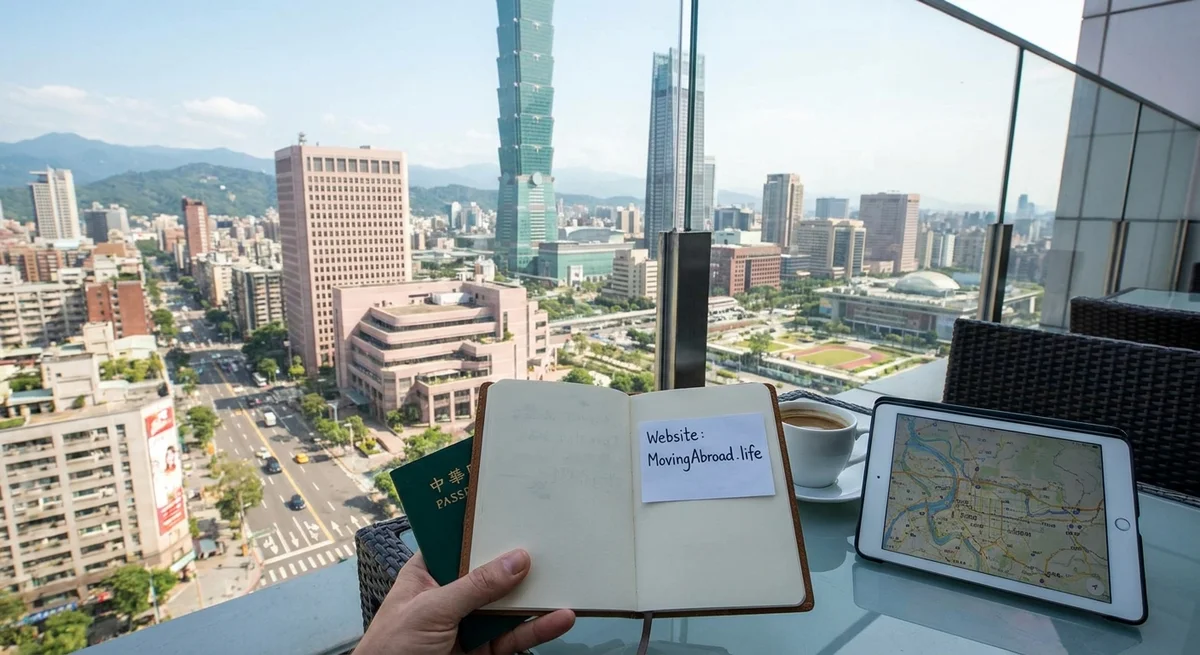
Taipei, Taiwan: Gold Card Gateway to East Asia
Introduction
Taipei, Taiwan’s bustling capital, is increasingly on the radar of expats seeking a safe, modern gateway to East Asia. This “world-class city,” as one recent survey notes, ranks 4th safest globally (www.chinatimes.com). Crime is extremely low and public services (police, transit, hospitals) are reliable. Taipei’s clean streets, efficient metro, and friendly locals make it feel secure day or night. In U.S. government travel advisories, Taiwan is rated “Level 1 – Exercise Normal Precautions,” with the main cautions being natural hazards (earthquakes, typhoons, floods) rather than crime (travel.state.gov).
Practically speaking, Taipei offers excellent connectivity (flights to nearby Asian hubs, fast trains to southern Taiwan) and high living standards at a lower cost than Tokyo or Seoul. Earners, retirees or digital nomads often find they can stretch their budgets here. Safety, healthcare, and quality of life are top-notch, but prospective movers should also weigh local tradeoffs (typhoon season, building codes for earthquakes, and Mandarin as the lingua franca). This guide will walk through the key factors – safety, cost, visas, healthcare, taxes, climate, transit, education, and more – to help you decide if Taipei fits your expat goals.
Safety and Security
Taipei is consistently hailed as very safe. In a 2023 global city survey Taipei placed 4th worldwide for safety, with a crime index far below other cities (www.chinatimes.com). Violent crime is exceedingly rare; most expat concerns are minor (e.g. taking care of possessions in crowded markets). Police response is professional and emergency services run smoothly. Domestic incidents like petty theft or scams can happen – as in any big city – but statistics show Taipei’s overall crime rates are among the lowest globally (www.chinatimes.com). U.S. authorities advise only normal precautions, noting instead that Taiwan’s main risks are natural events: earthquakes, typhoons, floods and extreme heat (travel.state.gov).
Neighborhoods popular with expats – Da’an, Xinyi, Tianmu, and the business districts – are well-patrolled and family-friendly. Some livelier areas (e.g. nightlife spots in Xinyi, Zhongshan) late at night warrant usual caution. Overall, Taipei’s excellent street lighting, 24/7 convenience stores and ubiquitous CCTV cameras add to a sense of security. In short, most foreigners report feeling safe walking around at all hours.
Cost of Living and Housing
Housing: Rents in Taipei are among the city’s biggest expenses, but they still undercut Tokyo and Seoul. In central Taipei, expect to pay NT$20,000–40,000 (US$600–US$1,200) for a one-bedroom apartment. For example, data-driven housing guides show a Da’an District 1-bedroom rents around NT$18,000–28,000 (affordwhere.com). In Xinyi District (the high-end financial zone), rents are higher – roughly NT$22,000–35,000 for a small flat (affordwhere.com). (Subletting from another tenant usually adds a premium.) The leafy Tianmu area (north Taipei) – known for large, international-school–style apartments – often runs in the same broad range or a bit higher for roomy quarters. Detached houses (“透天厝”) are very rare in Taipei proper; most expats live in mid- or high-rise condos.
Budgets: Overall, Taipei is notably cheaper than Tokyo and Seoul. Cost-of-living sites estimate a single person can live (rent+food+utilities) on roughly USD $1,300–1,500 per month in Taipei, versus ~$1,700+ in Tokyo or Seoul (livingcost.org) (citycost.org). For example, the same index puts Taipei ~26% less expensive than Tokyo ($1,257 vs $1,698) (livingcost.org). A recent comparison found a single-person budget $1,495 in Taipei vs $1,744 in Seoul (citycost.org). These figures include housing and basic expenses. In practice, many expats find monthly budgets (for a couple or small family) of NT$80k–120k ($2,500–3,800) are adequate. Eating out, groceries and public transit are inexpensive – a subway ride is only ~$0.60–1.00 US, for instance.
In short, your rent will likely be NT$20–40k/month (~$600–$1,200), cheaper than in equivalent Tokyo/Seoul districts, and your overall cost of living is correspondingly lower (livingcost.org) (citycost.org). Of course, imported goods (North American or European brands) can be pricey, and Taipei’s nightlife and dining scene can tempt even budget-minders!
Taiwan Employment Gold Card (Work Visa)
For foreign professionals, Taiwan’s Employment Gold Card is a standout perk. This single unified document (available in 1-, 2-, or 3-year terms) combines your work permit, resident visa/ARC, and re-entry permit. Most importantly, it grants an open work authorization: you can legally work for any employer (or multiple employers), or even freelance or start your own business, without needing a job-specific visa (goldcard.nat.gov.tw). Official sources describe it simply as a “combined open work permit, residence permit and visa” for skilled expatriates (goldcard.nat.gov.tw).
To qualify you must meet criteria like having a certain skill credential or minimum income (roughly US$50,000/year, though exact rules vary by field). The application is entirely online via the official Taiwan Gold Card site. Processing is fast (~30 days once documents are in order), and the fee is only a few hundred USD. Spouses and minor children of Gold Card holders can join as dependents on family visas.
Notably, Gold Card holders join Taiwan’s National Health Insurance after only 6 months in country (expatlife.ai), and there are fiscal incentives too: new cardholders can exempt foreign-earned income above NT$3 million (~US$100k) from Taiwanese tax for up to 3 years (expatlife.ai). (After the exemption period, regular tax rules apply.) In practice, the Gold Card has made working and living in Taiwan very straightforward for many expats – far simpler than in neighboring countries.
Healthcare: National Health Insurance
Taiwan’s National Health Insurance (NHI) is universally lauded for quality and affordability. By law, any foreigner with a resident visa (ARC) must enroll in NHI, typically after six months of residence (www.nhi.gov.tw). (Those with employer sponsorship will usually be enrolled even sooner, on day one of work.) Premiums are very low by Western standards – roughly 5% of salary split between employee (~30%) and employer (~60%) (startup.sme.gov.tw) – covering doctor visits, hospital stays, prescriptions and major treatments with minimal copays. Expats come to appreciate having world-class hospitals and clinics accessible at public-insurance rates (often just a few dollars OOP).
For new arrivals, the waiting period means you should have short-term insurance in the first half-year, but after that you’ll enjoy the same coverage as locals. (Dependents like spouse/children under your ARC are also covered.) In sum, Taipei’s healthcare system is first-rate and highly cost-effective for expatriates, one of the city’s big quality-of-life advantages.
Taxation and Residency Rules
Taxation in Taiwan is relatively straightforward. The key is 183 days: a foreigner who stays in Taiwan for more than 183 days in a calendar year is considered a “resident” for tax purposes (www.ntbk.gov.tw). As a resident, you must file a single annual return (due by end-May) on income earned in Taiwan (plus any foreign-sourced income for services performed here). The tax rates are progressive (5%–40% as of 2025) after personal exemptions and deductions. If you stay less than 183 days in a year, you’re a non-resident and generally only taxed on Taiwan-sourced income via withholding (www.ntbk.gov.tw).
For Gold Card holders (or any expat), this means planning your stay if you want to minimize tax. In practice, many full-time workers will exceed 183 days anyway, in which case they pay taxes much like Taiwanese citizens do. Taiwan also has various tax credits and treaties depending on your home country, so it’s wise to consult an accountant. (One big plus: for the first three years on a Gold Card, any foreign income above NT$3m is fully tax-exempt, making it much easier to live here tax-efficiently (expatlife.ai).)
Climate, Natural Hazards, and Air Quality
Taipei’s climate is subtropical: summers (June–September) are hot and humid – daytime highs often reach 32–35°C (90°F) with humidity around 75–80%. Typhoons are common in summer/fall (roughly June–October); each year Taiwan sees multiple tropical storms and at least one or two violent typhoons. The country is well-prepared – buildings are built to code and typhoons bring city-wide drills, flight/bus cancellations, and occasional flooding – but it’s a factor to expect if you live here. Winters (December–February) are mild (10–20°C, 50s–60s°F) but damp, with occasional chilly northeasterly winds.
Taipei also sits near the Pacific “Ring of Fire,” so earthquakes are possible (though destructive quakes are rare in Taipei due to strict building standards). The U.S. State Department specifically calls out earthquakes and tsunamis as risks (travel.state.gov). Weighing this, be aware of emergency procedures and have basic earthquake kits at home.
On most days, Taipei’s air quality is acceptable, far better than pollutant-heavy Chinese cities. However, wintertime can bring haze and PM2.5 spikes (partially from industrial pollutants blown in from China, plus local traffic emissions). It’s worth checking local AQI forecasts if you have respiratory issues, but for most people the air is not a deal-breaker. In a positive note, Taipei has extensive parks and is uphill from mountains and sea breezes, which help keep the air fresh more often than not.
Transportation Infrastructure
Taipei’s public transit is one of Asia’s best. The MRT metro covers nearly all districts (with new lines opening regularly), and clean, efficient trains run from ~6 am–midnight. A single ride costs about NT$20–65 ($0.60–2) depending on distance. The city also has an excellent bus network and plentiful taxis (both inexpensive). For quick trips, the popular public bike-share (“YouBike”) has thousands of stations citywide – a 20-minute bike ride can bypass traffic altogether.
Traffic jams can occur like any city, but Taipei’s compact size (around 2.6 million population) keeps average commutes relatively short – many expats quote 30–40 minutes end-to-end on public transit. Major trains (TRA) and the high-speed rail connect to other cities in Taiwan (e.g., Taipei–Kaohsiung in ~1.5 hrs). Plus, Taoyuan International Airport is only 30–40 minutes away by express bus or MRT. In short, getting around Taipei (and beyond) is easy, saving time and stress compared to cities with poorer transit.
Education: International Schools
For families, Taipei offers a strong lineup of international schools, mostly concentrated in Shilin and Tianmu. The largest is Taipei American School (TAS), offering K–12 American-style education; also prominent are Taipei European School, Morrison Academy, and Kang Chiao International School, among others. These schools typically charge high tuition (often NT$500,000–1,000,000/year, i.e. $15k–30k) (international-schools-guide.com). (For example, TAS lists tuition ~NT$957k–1,055k for 2026–27 (international-schools-guide.com); Taipei European School is about NT$554k–836k (international-schools-guide.com).) While expensive, they provide much of the same curriculum (IB, AP, American/European) and campuses as you’d find in Singapore or Hong Kong.
Beyond that, Taipei City schools are improving with bilingual programs, but local public schooling is Mandarin-based. Some expats pair children’s schooling with domestic or international options (bus or train to Taipei American School from outside Taipei is common). In short, if top-tier international K–12 education is a high priority, be prepared for substantial tuition costs. The upside is that Taipei’s expat population is well-served and many families report high satisfaction with the quality of instruction and school community.
Cultural Life and Trade-Offs
Living in Taipei is very convenient for expats – English signage is everywhere, electronic payments and apps streamline daily life, and most young people speak at least some English. That said, outside tourist and downtown areas, Mandarin Chinese is the daily language. Expats who learn basic Chinese (or even Taiwanese) find it much easier to integrate and navigate services.
Housing options skew toward apartments; those craving a backyard or a detached suburban home may find suitable neighborhoods only in very remote suburbs. High land costs mean even large apartments (e.g., 3–4 bedrooms in Xinyi) can be a significant budget item. If you value a standalone house, you’d mainly find multi-story townhouses in far-flung districts (and at higher cost). For most Taipei residents, condominium living is the norm.
Finally, Taiwan does have political tensions with mainland China, but daily life in Taipei is unaffected. Expats report that locals are friendly and inclusive. International cuisine and goods are widely available (and easier obtained in Taipei than in many Asian cities), and cultural life (theater, music, festivals, night markets, hiking) is rich and accessible.
Conclusion
Taipei offers a compelling blend of safety, affordability, and modern infrastructure that Western expats and others find very attractive. It’s often cheaper than Tokyo or Seoul while providing similarly high standards of healthcare, transportation and schooling. The Taiwan Gold Card makes legal working and residency straightforward for professionals. Downsides include periodic natural hazards (typhoons, earthquakes), a humid climate, and a Mandarin environment outside expat circles. But for many, the positives outweigh these trade-offs. With open arms to foreigners and a top safety profile (www.chinatimes.com), Taipei can indeed be a “gold card gateway” to enjoying life in greater East Asia. As one expert put it, “In Taipei you will feel safe walking anywhere” (www.chinatimes.com) – a rare asset in today’s world.
Get New Relocation Research & Podcast Episodes
Subscribe to receive new research updates and podcast episodes about moving abroad, best places to live, expat life, remote work destinations, retirement abroad, cost of living, visas, safety, healthcare, and quality of life.