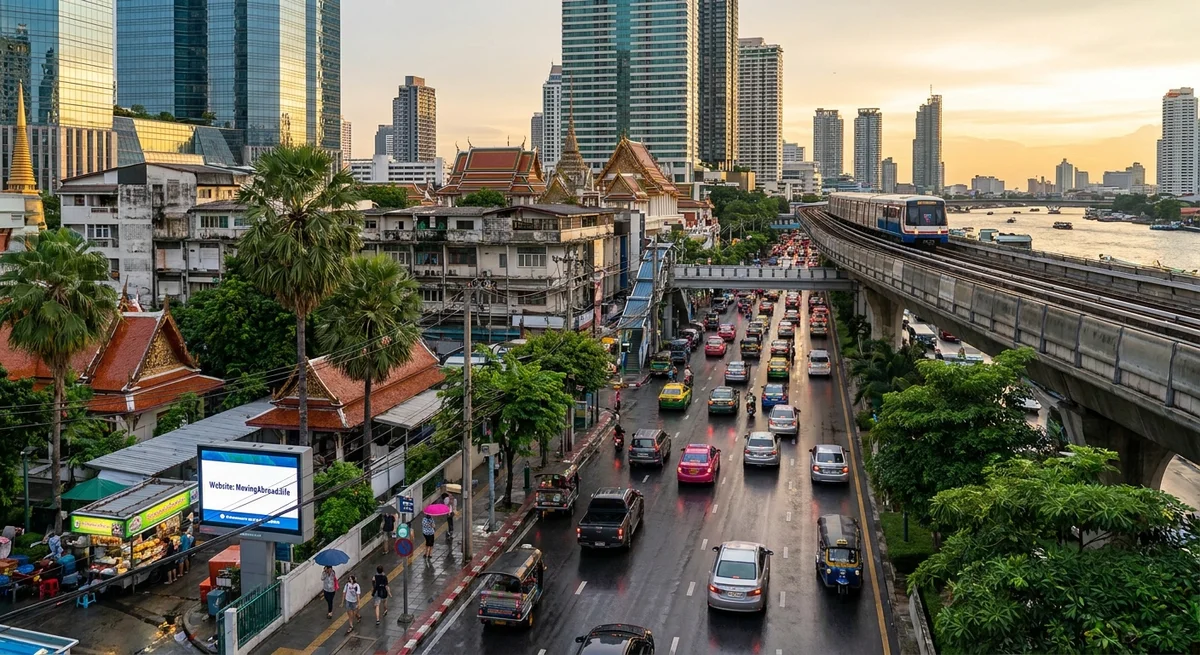
Bangkok, Thailand: Southeast Asia’s Most Complete Metropolis
Bangkok, Thailand: Southeast Asia’s Most Complete Metropolis
Bangkok is a vibrant megacity that blends modern infrastructure with rich culture – and for many expats it offers the best of Southeast Asia. The Thai capital boasts world-class hospitals, extensive public transit, and neighborhoods from leafy Ari to upscale Thonglor. However, it also has heavy traffic, bureaucratic visa processes, and a hot, humid climate. This guide dives into the real pros and cons of living in Bangkok. We break down safety, rental prices in Ari, Thonglor, and Sathorn, and typical budgets for different lifestyles. We cover visa options (including Thailand’s new Long-Term Resident program, work and education visas), taxes, and private healthcare quality and costs. We examine seasonal air quality, internet speed, and school choices. We also compare Bangkok’s experience to Ho Chi Minh City and Kuala Lumpur, highlighting key trade-offs on traffic, paperwork, and climate.
Safety and Security
By global standards Bangkok is relatively safe. Violent crime is low and most residents feel secure walking around during the day (nestopa.com). Bangkok’s overall crime index (Numbeo 2025) is about 61.7/100, higher than London or New York (nestopa.com). Serious offenses (murder, armed robbery) are rare and police clearance rates are high (thethaiger.com). In fact, Bangkok police reported a 17% drop in total crimes in 2025 compared to 2024 (thethaiger.com) (thanks to aggressive new patrols and high arrest rates). The vast majority of crime is nonviolent – petty theft, pickpocketing or scam schemes – rather than attacks on foreigners.
That said, expect the usual big-city nuisances. Scams targeting tourists (tuk-tuk tours upsells, gem scams) occur occasionally, and bribery and corruption are known issues (nestopa.com). Traffic accidents are a significant hazard – Thailand consistently has one of the world’s highest road fatality rates – so be cautious on the streets (especially if riding a motorbike). Demonstrations can happen, so avoid crowding around protest sites. The Australian travel advisory still urges “high degree of caution” in Thailand, mainly outside Bangkok, due to isolated insurgencies far south (nestopa.com). Within Bangkok proper, violent crime is rare and police are generally responsive.
Neighborhood safety: Most expat-friendly areas (Sukhumvit, Sathorn, Ari, Silom) are patrolled and feel secure. Crime tends to spike late at night or in less touristed districts. As a rule, stay vigilant at street markets and on public transit against pickpockets, and avoid walking alone in dark alleys. Overall, Bangkok sits in the “moderate” category for crime – safer than many Western capitals but not as quiet as Chiang Mai or smaller Thai cities (nestopa.com).
Cost of Living: Neighborhoods and Budgets
Bangkok’s living costs span a huge range depending on your lifestyle. In prime neighborhoods such as Ari, Thonglor, or Sathorn, expect higher rents and a richer social scene. Ari (north of downtown) is trendy and green, whereas Thonglor (Sukhumvit Soi 55) is flashy nightlife, and Sathorn (central business district) is mix of offices and luxury condos.
-
Thonglor rents: Thonglor commands among the highest condo rents in Bangkok. A modern one-bedroom (in buildings like The Lofts Ekkamai or Noble Remix) runs roughly ฿22,000–฿35,000 per month, depending on size and finish (www.superagent.co). Two-bedroom units in new high-rises often hit ฿45,000–฿70,000 or more. You’re paying for location and top-notch amenities (pools, gyms, 24/7 security).
-
Ari rents: Ari is generally more affordable. A comfortable one-bedroom there will cost about ฿14,000–฿22,000 (www.superagent.co). Two-bedrooms in Ari typically rent for ฿25,000–฿40,000. Smaller budgets stretch further – you often get newer layouts and full facilities at these prices. Ari’s quieter vibes mean rent per baht is lower than Thonglor’s party scene.
-
Sathorn rents: Sathorn’s central location and office district status push rents upward. Property data show one-bedrooms in Sathorn range from ฿20,000 up to 70,000 THB per month, depending on building age and finish (propertyscout.co.th). Large 2–3 bedroom units commonly go for ฿40,000–฿120,000 per month (propertyscout.co.th). Luxury towers in Sathorn can exceed those ranges (some penthouses rent for over ฿200,000), while older condos offer more modest deals.
Monthly Budgets by Lifestyle
Here’s a rough portrait of monthly expenses in Bangkok (all figures in Thai Baht, THB):
-
Shoestring/Budget lifestyle (~฿20,000–30,000): A minimal expat digs by sharing a room in outer suburbs or an older condo (<฿10,000 rent) (condoreviewsthailand.com). Street food and cooking keep food bills low (฿8,000–12,000); utilities and internet ~฿3,000 (condoreviewsthailand.com); local transport (monthly BTS pass or GrabBike) ~฿1,500 (condoreviewsthailand.com). Entertainment is frugal – local beers, one coffee a day (a few thousand baht). Total ~฿18–25k (thailandknowledge.com). This is lean but doable for a solo digital nomad or backpacker who refuses to overspend.
-
Mid-range/Comfortable (~฿45,000–70,000): The sweet spot for many young professionals. Rent
฿25,000–35,000 for a modern one-bedroom near BTS (Thonglor/Ekkamai/Ari) (condoreviewsthailand.com) or up to ฿40,000 depending on location. Utilities (฿3,500) and internet (~฿700) add a few thousand (condoreviewsthailand.com). Groceries and a mix of street/restaurant dining ~฿18,000 (condoreviewsthailand.com). Transport (BTS/E-scooters/Grab) ~฿3,000–5,000 (condoreviewsthailand.com). Decent private health insurance (basic expat plan) ~฿4,000–6,000 (condoreviewsthailand.com). Gym membership / social life / coffees / outings ~฿10,000–15,000 (condoreviewsthailand.com). Misc (visas, laundry, SIM) ~฿3–4k. Total: ~฿45–70k per month (thailandknowledge.com) (condoreviewsthailand.com). This covers one-bedroom rent in a decent condo, eating out a few times weekly, and a comfortable urban lifestyle. -
High-end/Premium (>฿100,000): For corporate expats or affluent entrepreneurs, Bangkok can be very comfortable. Luxury condos, fine dining and private school add up. Expect ฿60,000+ rent for a spacious serviced condo, plus ฿20–60k+ on food (restaurants and imports) (condoreviewsthailand.com). Car ownership is possible but adds fuel and parking. Total easily tops ฿150k+ monthly for a family lifestyle, complete with private insurance and international schooling (about ฿500k–1.2M/yr per child (www.bkkschools.com)).
For reference, a recent cost-of-living survey notes Bangkok’s budgets roughly as ฿18–25k (very frugal), ฿45–70k (mid-range) and ฿90–140k (comfortable) (thailandknowledge.com). In practice, many say living “comfortably” on under ฿30k is unrealistic (condoreviewsthailand.com), because rents and insurances climb. Families should budget on the higher end: even groceries and utilities can near ฿15–20k a month for a couple with kids.
Comparison: HCMC and KL
For context, Bangkok’s costs sit above Ho Chi Minh City but are close to Kuala Lumpur[55†L22-L30][53†L14-L19]. Recent data show Saigon’s living costs ~15–20% below Bangkok, thanks to cheaper rents and food (www.asialifestylemagazine.com). For example, a modern 1BR in central HCMC often rents for only $450–$750 (฿17–26k) vs $650–$1,100 (฿24–40k) in Bangkok (www.asialifestylemagazine.com). Street meals tend to be a bit cheaper in Vietnam, too. Kuala Lumpur is comparable in cost: livingcost.org reports Bangkok ~5% pricier than KL overall (livingcost.org). In both comparisons, Bangkok often wins on infrastructure and convenience (BTS/MRT, hospitals), while Saigon and KL offer slightly lower day-to-day expenses.
Visa Options and Bureaucracy
Thailand has a bewildering array of non-immigrant visas, and Bangkok’s residency rules have recently changed. The big news is the Long-Term Resident (LTR) visa, launched in 2024. The LTR is a 10-year multiple-entry visa (initial 5+5 year stays) aimed at four groups: Wealthy Global Citizens (investors), Wealthy Pensioners, Work-from-Thailand Professionals (digital nomads), and Highly Skilled Professionals (ltr.boi.go.th) (www.boi.go.th). It offers big perks: permission to work (with a streamlined “digital work permit”), a flat 17% income-tax rate (for the Skilled Prof. category), exemption from the usual 90-day reporting requirement, airport fast-track, and even tax breaks on overseas income (www.boi.go.th). High net worth applicants (wealthy visa) need ~$1M USD in assets and investment conditions, professionals need ~$80k/yr income (www.boi.go.th). In short, LTR is designed to lure affluent expats and remote workers with a one-stop bureaux process and long-term stability.
Outside LTR, the usual routes still apply. A Non-Immigrant B (Business) visa is required to work legally in Thailand. This means getting a Thai company to sponsor you (the company must hire 4 Thais per foreign), then securing a work permit. Many expats join small business visas initially via language schools or coaching. If you’re self-employed, you typically need to set up a Thai company or use a “visa-by-investment” scheme (like Thai Elite or BOI-approved investment jobs).
Students can apply for a Non-Immigrant ED (Education) visa when enrolled full-time at a Thai school or university. It allows study and also (with separate permission) up to 20 hrs/week work. The popular Own Retirement (O-A) visa grants 1-year stays (renewable) for those 50+ with ฿800,000+ in savings or monthly income. Thailand also re-introduced a Tourist visa option of up to 90 days for many nationalities, but be aware it does not allow work and requires periodic extensions beyond an initial 30/60 days. (Most expats avoid 1-year tourist visas unless they plan short stints or visa runs.)
Visas require paperwork, and Thai bureaucracy can feel slow. Every visa has renewal requirements (work permits depend on corporate license and hiring ratios, student visas need passing grades, etc.). The good news is a new One Stop Service Center in Bangkok’s One Bangkok complex is helping simplify visa/work-permit procedures for investors and LTR holders (ltr.boi.go.th) (www.boi.go.th). But for average expats there’s still the semiannual 90-day reporting and expensive re-entry permits if you travel. Overall, visa churn is a tradeoff – unlike Malaysia’s MM2H (My Second Home) or lenient EA 1-year visas in Vietnam, Thailand demands annual renewals (or LTR applications).
Taxes
Thailand’s tax system is straightforward but worth knowing. Tax residents (those staying 180+ days) pay income tax on Thailand-source income on a progressive scale up to 35% for incomes above ฿5 million/year (taxsummaries.pwc.com). The first ฿150,000 is tax-free, then rates climb gradually (5%,10%,… up to 35% (taxsummaries.pwc.com)). Non-residents are taxed only on Thai-earned income at a flat 15%. Notably, starting 2024 Thailand also taxes foreign income if it is brought into Thailand in the same year (taxsummaries.pwc.com) (a change from earlier rules).
Corporate tax is typically 20% on Thai companies (some small businesses can get relief). There’s a 7% Value-Added Tax (VAT) on most goods and services, with higher rates on alcohol/tobacco. Social security contributions are small (5% of monthly salary up to a cap, matched by employer). A key perk of an LTR visa is tax: overseas income can be exempt (for retiree, investor, remote worker categories) or capped at 17% (for skilled pros) (www.boi.go.th), significantly reducing liability.
For regular expats, filing is once a year by March or May. If you work for a Thai company, they withhold tax from your paycheck. Freelancers and company owners should budget 10–25% of income for taxes (depending on earnings), plus a possible 1% withholding on big purchases. The bottom line: Thailand’s tax rates are comparable to many countries, but paperwork requires care. Engage an accountant or your company’s finance team during visa renewal seasons.
Healthcare: Quality and Costs
Bangkok is one of the world’s premier medical hubs. The city hosts dozens of internationally accredited private hospitals with cutting-edge technology and English-speaking staff. For example, Bumrungrad International Hospital on Sukhumvit treats over 1.1 million patients per year (roughly half from abroad) (www.superagent.co). Leading medical journals and WHO rankings often list Bangkok hospitals among Asia’s best.
Practically, this means fast, high-quality care – but at a price. A simple GP visit or minor procedure in a top private hospital typically costs a few thousand baht. For instance, one expat’s routine knee MRI, doctor consultation and treatment at Samitivej hospital ran about ฿18,000 (~$500) (www.superagent.co) – easily ten times cheaper than US prices for similar service, yet more than a bargain relative to the Thai public system. Private hospital outpatient consultations often range ฿2,000–5,000 (US$60–150) depending on specialty (www.superagent.co), whereas public hospitals might charge only a few hundred baht but with long waits and Thai-only staff.
Most expats opt for international health insurance. Premiums vary by age and plan, but budget at least ฿3,000–8,000 per month for a decent expat policy covering hospitalization (condoreviewsthailand.com). Even basic private insurance helps avoid spending tens of thousands out-of-pocket for serious issues. Pharmacies are plentiful, and many medicines are available over-the-counter (though without consultation).
Public hospitals (Siriraj, Ramathibodi) are excellent teaching hospitals, but navigating them can be challenging without Thai. For day-to-day minor ailments, many expats also use 24-hour private clinics (e.g. Bangkok International Clinic, Samitivej Pediatric Center) where a GP consult costs around ฿500–1000. Dental care and specialists are world-class here.
In sum, Bangkok healthcare is world-class at local prices. Routine care remains affordable, but serious hospitalizations add up quickly without insurance. Most retirees and families consider a solid global health plan mandatory.
Air Quality and Climate
Air Quality: Bangkok’s pollution is a real concern, especially in dry months. In 2023 the city saw only 31 days of “Good” air quality (Green) – most of the year ranked Moderate to Unhealthy for Sensitive groups (www.nationthailand.com). By some measures, April can be the worst: the average PM2.5 in Bangkok that month was about 115 µg/m³ (the WHO guideline is 15 µg/m³ daily) (www.nationthailand.com). In practice, residents often experience haze from vehicle exhaust, construction dust, and regional burning.
Seasonally, air quality tends to peak (worsen) in the Thai cool season. Late December through February often have stagnant air, raising PM2.5 and PM10. Official data show higher pollution in winter (Dec–Feb) and much cleaner air in the rainy season (greenoffice.bangkok.go.th). The monsoon (June–Sept) typically washes particulates out of the air. (Ironically, some analyses blame April’s bad readings on farm fires and peak traffic.) Bangkok’s summer (March–May) is hot and fairly humid, which can trap pollutants on still days.
For expats, this means investing in an N95 mask for bad days, and possibly an air purifier if you have respiratory issues. Bangkok traffic and construction means motorists often get a lungful unless you use a proper mask. However, most foreigners report noticeable relief once the rains arrive each May. Compared to Chiang Mai or northern Thailand, Bangkok’s winter smog is milder but still significant.
Climate: Bangkok is tropical savanna climate – hot year-round with a pronounced monsoon. Average temperatures range roughly 24°C (December nights) to 34°C (April highs) (de.climate-data.org) (www.nationthailand.com). The hottest months are March–May, with daytime peaks often in the mid-30s °C (mid-90s °F) and extreme heat occasionally. Humidity is high, so 35°C can feel oppressive. By contrast, Kuala Lumpur and HCMC see heavy rainfall in summer that cools the air slightly; Bangkok’s “summer” is mostly dry and sweltering. Even winter (Dec–Feb) stays around 25–30°C (though with lower humidity and cooler nights).
Rainy season runs roughly May–October. Afternoon thunderstorms are common, especially Aug–Sept. Annual rainfall exceeds 1500 mm. Hurricanes don’t hit Bangkok, but torrential rains can cause flooding in some areas (though Bangkok’s flood defenses have improved since the 2011 crisis).
In short, if you dislike heat, Bangkok can be tough. The combination of heat and humidity from March to June is a dealbreaker for some. On the upside, the long “cool” season still feels warm by temperate standards and sunshine is almost guaranteed year-round. winters are the sunniest and most comfortable time to explore outdoors.
Transportation and Internet
Transit: Bangkok’s public transit is one of its greatest assets compared to peers. The BTS Skytrain (Sukhumvit and Silom lines) and the MRT subway (Blue, Purple, future Yellow/Orange lines) form a growing rapid-transit network. These rails now cover key zones: Sukhumvit from Mo Chit (north) through Phaya Thai to Bearing (east), Silom Line from National Stadium to Bang Wa (west), MRT Blue looping through the city center, and expanding into suburbs. Stations in Thonglor, Ari, Sathorn, and most business districts provide fast, air-conditioned commutes. During rush hour, BTS/MRT travel is vastly faster than taxis. For example, a trip from Ari area to Lumphini Park takes about 20 minutes by BTS (plus a transfer at Siam) (www.superagent.co), whereas the same trip by taxi in evening traffic can exceed 45 minutes (www.superagent.co). Monthly Skytrain passes are around ฿1,300–1,500, and single rides run about ฿20–60 ($0.50–$1.50) depending on distance (www.asialifestylemagazine.com).
If you live near the rails – as many expats do to avoid gridlock – getting around is quick and cheap. Bangkok also has a growing Airport Rail Link ($2 from Suvarnabhumi to downtown) and a new Gold Line tram servicing Thonburi riverside. Buses are plentiful (but slower); taxis and motorbike taxis (via Grab or local operators) are ubiquitous and inexpensive by Western standards. GrabCar rides cross-town typically run $3–8 (parallel distances in HCMC are ~20–30% cheaper (www.asialifestylemagazine.com)).
Traffic remains a major downside. Outside the air-conditioned rails, Bangkok’s roads can crawl in morning and evening rush. Recent reports rank Bangkok as very congested (one study had Bangkok’s 10km drive taking ~22 minutes on average) (nikkantb.com). Car owners face multi-hour commutes. Motorbikes and taxis ply every lane in chaos. This underscores the importance of location and transit: living on a BTS line can literally cut a 45-minute ordeal to a 20-minute ride (www.superagent.co).
Internet: High-speed internet in Bangkok is generally excellent. Fiber-optic broadband is widely available in apartments and condos. Typical home internet plans offer 300–800+ Mbps download (www.expatsinthai.com), plenty for video conferences and streaming. Thailand’s three major ISPs (True, AIS Fibre, 3BB) frequently advertise 200–500 Mbps at ~ ฿700–1,000/month. 5G mobile coverage is also strong in the city: surveys record Bangkok 5G speeds in the 150–400 Mbps range (www.expatsinthai.com) for AIS and True. In short, whether wired or wireless, Bangkok’s connectivity rivals anywhere in Asia. (Compare KL’s average broadband ~100 Mbps – Bangkok typically higher (expatlife.ai) and with more gigabit options.)
Education and Schools
Bangkok is Southeast Asia’s largest hub for international education. There are 40+ international schools, serving the expat and affluent Thai communities (expatschoolguide.com). Curricula include British (IGCSE/A-Levels), American (AP), International Baccalaureate, and bilingual programs. Popular schools include Bangkok Patana, NIST, St. Andrews, Shrewsbury, Harrow, among others.
Fees are steep: international school tuition ranges roughly ฿300,000–1,200,000+ per year (for all grades) (expatschoolguide.com) (www.bkkschools.com). For example, top-tier IB or British schools charge on the order of $15,000–30,000 USD annually (≈฿500k–฿1,000k) (www.bkkschools.com). Many schools have variations by age (younger students slightly cheaper). Schools often require separate payments for registration, uniforms, transport, and annual fees. (Semi-private or bilingual schools can be cheaper – around ฿200k/yr – but still significantly above Thai public-school costs.)
Public Thai schools in Bangkok are mostly Thai language, lengthy, and not the norm for foreigners. Some expats do enroll children in international sections of Thai schools or IB programs. A few new bilingual Thai/English “international” schools have opened with relatively moderate fees, but family budgets must plan ~฿20,000–30,000 per child per month if schooling is needed.
In short, Bangkok offers top-quality K–12 education facilities that satisfy every curriculum need, but at a price. Expats with kids should expect schooling costs to substantially increase their budget (international education easily adds $8,000–18,000 per child annually (www.asialifestylemagazine.com) on top of daily living). That said, quality-wise Bangkok ranks among Asia’s best for expat schooling.
Trade-offs: Traffic, Bureaucracy, and Weather
Living in Bangkok’s fast-paced embrace comes with trade-offs. Here are some of the biggest ones to weigh:
-
Traffic Congestion: As noted, Bangkok’s traffic is legendary. Owning or driving a car can become frustrating—the same 10km trip that a BTS train does in 15 minutes can easily take an hour by car in peak traffic (www.superagent.co). Motorcycle taxi or subway is often faster than car. Even Grab bike rides double in price and time during rush hour. Many expats advise living near the BTS/MRT to avoid daily gridlock. Ultimate driving patience is mandatory if you love expat ‘roadtrip’ culture.
-
Visa and Bureaucracy: Thailand’s bureaucracy can be slow and ever-changing. You’ll spend time each year renewing visas, permits and 90-day reports (unless you secure an LTR or Elite Visa). Immigration rules can tighten suddenly (as happened with Covid bans or revisions to retirement visa requirements). Compared to Malaysia’s MM2H or simple 1-year Vietnam visas, Thai red tape feels heavier. However, new programs (LTR, digital one-stop visa centers (ltr.boi.go.th) (www.boi.go.th)) aim to streamline this. In practice, be ready to budget for visa fees (hundreds of dollars per renewal or permit) and perhaps a visa agent.
-
Seasonal Pollution: As above, wintertime haze may force lifestyle adjustments (pollution masks, indoor gym days, etc.). If you or family members have respiratory issues, the dry season’s PM2.5 is a factor HCMC and KL expats must note. Kuala Lumpur’s air quality is relatively stable (except seasonal haze from Sumatra fires), and Ho Chi Minh’s worst Air Days tend to coincide with Bangkok’s (March–April) (www.nationthailand.com). But Bangkok’s higher urban density can mean more smog on bad days.
-
Summer Heat: Bangkok’s pre-monsoon heat is intense. April afternoons can feel hotter than KL or Saigon, because Bangkok’s humidity stays high. By comparison, KL’s heavy rains in the monsoon mitigate daytime heat, and HCMC’s coastal breeze can provide relief. If you don’t enjoy scorching sun, Bangkok’s March–May period can be the biggest downside. It at least prompts a culture of air-conditioning and encourages early-evening strolls instead of midday outings.
-
Cost of Living Trade-offs: You trade off higher prices for richer amenities. Bangkok’s quick trains, international schools, and hospital ranks surpass what HCMC offers today. For example, Bangkok’s healthcare (Bumrungrad, Samitivej) is unparalleled regionally (www.asialifestylemagazine.com), whereas Saigon is still developing. KL offers widespread English fluency and modern infrastructure (good road network, low taxes, Malaysian wellness incentives) which Bangkok slightly lacks. In short, you pay more for the Bangkok crown city experience. A family may spend 10–20% more in Bangkok than HCMC on rent and food (www.asialifestylemagazine.com), but benefit from greater international connectivity and conveniences. Versus KL, Bangkok’s living costs and salaries are roughly similar (livingcost.org), but KL’s higher local incomes and tax advantages give expats a slight edge in disposal income.
Conclusion
Bangkok stands out as Southeast Asia’s most complete megacity for expats: it has a vast, modern infrastructure, excellent (though pricey) healthcare, top-tier schools, and a huge expat community. Neighborhoods like Thonglor, Ari, and Sathorn each have distinct flavors – glamorous nightlife vs. local-cool vs. financial-hub calm – and rents ranging roughly ฿15k–70k for one-bedrooms (www.superagent.co) (propertyscout.co.th). Monthly living expenses can be modest (฿20k in a budget scenario (thailandknowledge.com)) or stretch well into six figures upon premium lifestyles.
The Thai government’s new LTR Visa makes long-term residence easier for certain high-income foreigners (ltr.boi.go.th) (www.boi.go.th), but regular expats still juggle work visas and renewals. Bangkok’s taxes are moderate (up to 35% income tax (taxsummaries.pwc.com)), though the LTR program can lock many at 17%.
On the downside, Bangkok’s traffic and bureaucratic overhead are its famous trade-offs. Heavy traffic jams test patience in daily commutes, and visa paperwork requires diligence. The climate can be extreme: baking hot from March to May, and winter months with hazardous air pollution.
Compared to peers, Bangkok’s higher living costs buy a level of comfort and amenities unmatched in the region. Ho Chi Minh City runs 10–20% cheaper overall (www.asialifestylemagazine.com) but has more limited infrastructure; Kuala Lumpur is comparably priced (livingcost.org) (with its own benefits like better English and tax breaks). In the end, many expats choose Bangkok for its convenience, healthcare, transit and sheer variety of lifestyle options, accepting traffic and paperwork as the price of entry.
Whether you’re a remote worker, retiree, or family, Bangkok can deliver – if you plan carefully. Do your homework on neighborhoods and budgets, secure the right visa up front, and prepare for hot summers. With that, you’ll find Bangkok’s energy and depth are hard to beat in Asia’s relocation landscape.
Get New Relocation Research & Podcast Episodes
Subscribe to receive new research updates and podcast episodes about moving abroad, best places to live, expat life, remote work destinations, retirement abroad, cost of living, visas, safety, healthcare, and quality of life.