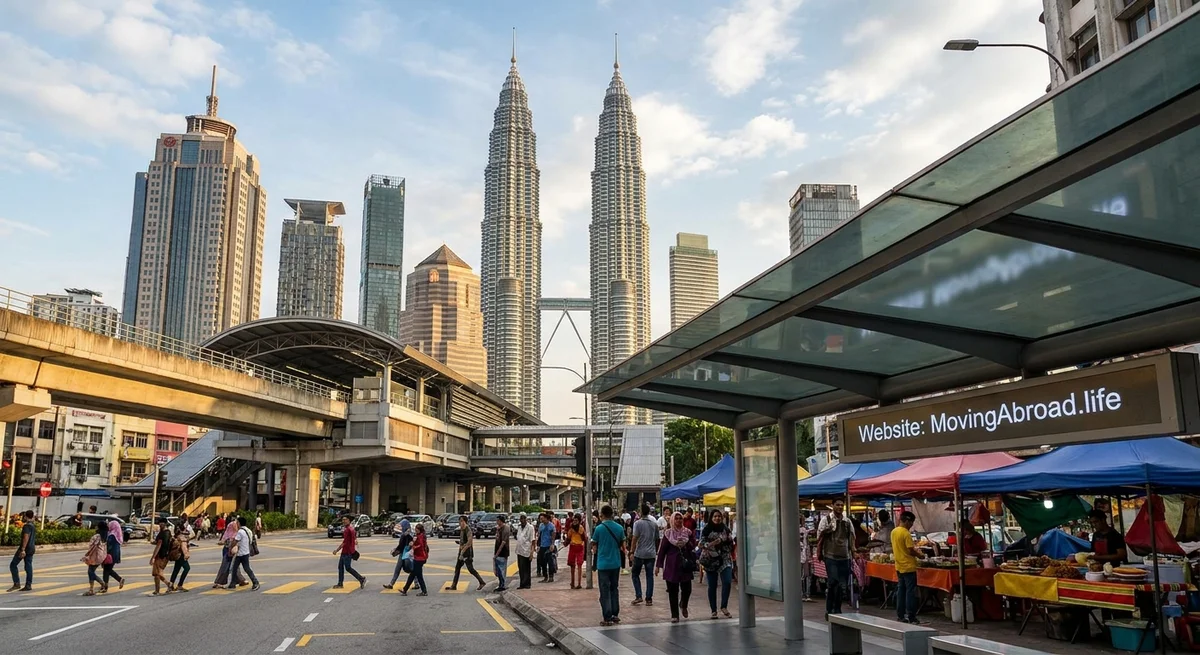
Kuala Lumpur, Malaysia: Big-City Value With Regional Access
Kuala Lumpur at a Glance
Kuala Lumpur (KL) is Malaysia’s booming capital – a modern, multicultural city that offers big-city amenities at lower cost than many regional peers. It combines gleaming skyscrapers and shopping malls with Malay, Chinese and Indian communities. Expats praise its reliable broadband, widespread English and affordable homes (nomads.com) (malaysia4u.com). But it comes with trade‐offs: seasonal haze can be intense, traffic jams are common, and some long-term visa rules recently changed. Below we examine key factors for anyone considering a move to KL – from safety and rents to visas, healthcare, transit, schools and cultural fit – comparing to Bangkok and Singapore where relevant.
Safety and Security
Overall, Kuala Lumpur is generally safe, especially in central and expat neighborhoods. Violent crime is relatively uncommon, though petty theft and opportunistic scams do occur (as in any large city). Expat guides and nomad surveys call KL “functional and clean with decent safety” (nomads.com). As a Southeast Asian capital, KL is safer than many regional cities; for example Numbeo’s crowd-sourced data shows KL’s crime index well below Bangkok’s (chiangmaibusiness.net). Nevertheless, it’s wise to take common-sense precautions: avoid poorly lit outskirts at night and keep luggage/funds secure. Tourist-heavy spots (Night Market, Chinatown) have pickpockets on occasion.
By comparison, Singapore is even safer (often ranked among the world’s safest cities), with extremely strict laws and virtually no street crime. Bangkok and Jakarta report more theft and street con jobs than KL, though Singapore’s police/state controls are far tighter. Many expats find KL’ risk profile acceptable: you can walk alone at night in most neighborhoods, and local police are attentive, but one hears more about cell-phone snatches or vehicle break-ins here than in Singapore. Anecdotally, English-speaking residents (and heavy tourist traffic) keep a level of vigilance – all foreigners are potential targets for lone thieves or ATM fraud.
According to travel advisories and surveys, Southeast Asia’s safest cities currently rank Chiang Mai and Singapore above Kuala Lumpur (chiangmaibusiness.net). KL sits comfortably below Bangkok and Manila on raw crime stats, though metrics like Numbeo’s “Safety Index” controversially rate it lower (chiangmaibusiness.net). In practice, most expats report feeling secure in KL’s barangays (especially Mont Kiara, Bangsar) and in well-traveled districts. Still, we recommend staying alert in markets/monorail stations or during evening outings (avoid isolated areas, secure your belongings). The city’s emergency services and international hospitals are well-rated, offering reassurance for residents.
Key takeaway: Kuala Lumpur is moderately safe by regional standards. Violent crime is rare. Petty crime (bag snatches, fraud) is the main risk. Exercise normal urban caution. Singapore remains safer overall; Bangkok slightly riskier. KL’s friendly neighborhoods and visible police presence earn it a solid safety reputation for expat families and solo nomads alike (nomads.com).
Cost of Living and Housing
One of KL’s biggest draws is value. A high-quality lifestyle here costs far less than in Singapore or most Western cities. Expat cost-of-living trackers estimate that an average single person’s monthly expenses (including a decent one-bedroom apartment) are around MYR4,180 (~USD $940) (everycity.guide). That number rose modestly (≈1.4% YoY in Q2 2026), driven by small increases in rent and groceries (everycity.guide) (livingcost.org). (For comparison, Singapore’s index runs roughly 65–180% higher – e.g. about $3,100/month for a similar lifestyle (livingcost.org) (expatistan.com).)
Rents in Bangsar, Mont Kiara, KLCC
Housing dominates the budget. Among expat enclaves, rents vary by neighborhood and building. According to recent market surveys:
- KLCC/Bukit Bintang area: One-bedroom serviced apartments average RM2,800–2,850 per month (everycity.guide) (everycity.guide). High-end condos (e.g. Banyan Tree, Four Seasons Place) can fetch RM6,500–12,000 (everycity.guide).
- Mont Kiara: Another popular expat area, 1BR asking rents are about RM3,150–3,200 (everycity.guide) (everycity.guide). This trendy suburb (on the Bukit Tunku/Sri Hartamas corridor) has many luxury complexes with pools and gyms.
- Bangsar: A leafy, centrally located district. One-bedroom units here run roughly RM2,900–3,000 (everycity.guide). Places like Bangsar South and Taman Tun Dr. Ismail (nearby) are similar to slightly cheaper (RM2,400–2,950) (everycity.guide).
For families needing more space, two-bedroom apartments in Mont Kiara or KLCC typically cost RM4,500–8,500 per month (everycity.guide). Two-bedrooms in Bangsar/TTDI go for about RM3,200–4,500, while outer suburbs (Petaling Jaya, Cheras) can be RM2,200–3,000 (everycity.guide). Lease terms normally require double rent as deposit (plus a small utility deposit and stamping fee (everycity.guide)) and 1-year contracts are common.
Monthly Budget Examples
Putting it together, expat budgets look roughly like this:
- Budget single expat: RM4,000–5,500/month. This covers a modest 1BR, basic groceries, utilities and occasional dining out.
- Middle-class single: RM6,000–8,000/month for a nice one-bedroom in Mont Kiara or Bangsar with better amenities (rumavi.com), plus eating out, gym, etc.
- Family of four (with kids): Easily RM18,000–28,000+/month. This includes rent for a 2–3BR apartment in a good school zone (RM4,000+), international school tuition (see below), school transport and activities, plus all living costs (rumavi.com). (Note: tuition for two children at top schools alone can be RM100k+ per year (rumavi.com)—see International Schools section.)
One cost guide notes that “living in Kuala Lumpur costs RM6,000–9,000 per month for comfortable singles” and RM18,000–28,000+ for families with school fees (rumavi.com). This aligns with cost-of-living sites: for instance, LivingCost.com reports about US$981/month (~RM4,400) for a single person (lifestyle including rent) (livingcost.org). Bottom line: KL offers Western conveniences and safety at roughly half or less the price of major global cities (especially compared to Singapore, Hong Kong or Western capitals) (livingcost.org) (rumavi.com).
Taxes and Salaries
Malaysian taxation is relatively moderate. The top personal income tax rate is 30% (quickbooks.intuit.com) (much lower than many Western countries). Notably, Malaysia currently does not tax foreign-sourced income received by residents (an exemption extended through 2026) (kpmg.com) (themalaysianguide.com). In practice, this means remote workers or retirees paying themselves from overseas enjoy a tax break. Social welfare contributions for non-citizens are minimal.
Incomes vary widely, but expats often note that KL salaries lag regional financial hubs. Average Malaysian salaries are modest, so expect that living costs are normally covered by expat/remote incomes or local managerial pay (or retirement funds). The national minimum wage (2024) is just RM1,500/month, whereas engineers or managers might earn RM6k–12k (or USD10k+ for multinationals). Stronger currencies (USD/EUR/GBP/AUD) stretch far here. Factor in healthcare and schooling costs (see below) when budgeting.
Insider tip: Utilities, fuel and local groceries are very cheap by Western standards. A typical monthly grocery basket is about RM700–750 (everycity.guide). Electricity, water, Internet and gas for a small flat run only ~RM240 (everycity.guide) per month. Public transit passes (MRT/LRT) are also inexpensive (~RM100/month) (everycity.guide) (though many expats prefer ride-hails or cars).
Visas and Residency Options
Malaysia offers several long-stay visa routes – and some confusion as rules evolve. The old MM2H (Malaysia My Second Home) program was relaunched in late 2023 and revised in 2024, while a new digital nomad visa (“DE Rantau Nomad Pass”) arrived in 2022. Below is the 2024–25 situation:
DE Rantau Digital Nomad Pass
For remote workers and freelancers, the DE Rantau Nomad Pass (launched 2022 by MDEC) grants legal residence to work online for foreign clients**. It is valid for 3, 6, or 12 months (renewable up to 24 months) (themalaysianguide.com). To qualify you need:
- Non-Malaysian employer/clients: You cannot work for Malaysian companies on this visa (themalaysianguide.com).
- Income proof: At least USD 24,000/year (about RM113k) from overseas work (themalaysianguide.com).
- Health insurance: You must have travel or medical insurance covering emergencies in Malaysia (themalaysianguide.com).
- Application: Apply online (fee ~RM1,060) and receive approval, then get a visa stamp on arrival (themalaysianguide.com).
Approved nomads get multiple entry status, Malaysian bank accounts, and can bring spouses/children (themalaysianguide.com). Note: no path to permanent residency is granted. Critics note the RsM economy wants only high earners ($2k/mo+).
Importantly, foreign income is not taxed under this program (themalaysianguide.com) (Malaysia still follows the current exemption rule (kpmg.com)). If you become tax-resident (>182 days), local-sourced income (if any) would be taxed, but overseas earnings remain free. (themalaysianguide.com) (kpmg.com).
The DE Rantau scheme is actively expanding. As of June 2024 the Malaysian government opened it to non-tech professionals too: founders, managers, accountants, legal counsel, artists, etc. can apply (as long as they meet income criteria) (www.digital.gov.my) (www.digital.gov.my). The raised minimum for such roles is USD60,000/year (about RM270k). These changes aim to keep Malaysia competitive with other nomad-friendly countries.
Alternative: For stays under 3 months, tourists from many countries get visa-free entry or visas-on-arrival. Multiple short visits on a 90-day tourist visa are common for digital nomads, but the DE Rantau pass is the first formal “remote work” visa here.
MM2H (“Malaysia My Second Home”)
The MM2H program has been overhauled recently. Since December 2023, there are three tiers (in USD) (malaysia4u.com):
- Silver: USD 150,000 fixed deposit (FD), 5-year visa. (Applicants must be ≥35 years old) (malaysia4u.com).
- Gold: USD 500,000 FD, 15-year visa.
- Platinum: USD 1,000,000 FD, 20-year visa.
These replaced the old ringgit-based rules. (Note: Sarawak state offers its own S-MM2H permit with much lower requirements – e.g. RM150,000 FD – favored by many retirees (malaysia4u.com).)
Recent news (June 2024) clarified that Platinum no longer grants permanent residency – it’s a 20-year permit instead (www.imidaily.com). The Gold deposit was reduced from RM2M to RM1M (about USD 420k) for Gold tier (www.imidaily.com). MM2H holders can partially withdraw 50% of their FD after one year for specific uses (property purchase, healthcare, etc.) (www.imidaily.com). All tiers require applicants to be 25+ (Silver applicants now 35+) and have offshore incomes (USD 10k/mo for Gold/Platinum).
In summary, the new MM2H offers long residencies (5–20 years) for wealthier applicants, but it remains mainly a retirement/investor visa – no work rights are included by default (malaysia4u.com) (malaysia4u.com). The program also stopped offering a direct PR path (www.imidaily.com). If you’re less affluent, consider living in Sarawak (Kuching/Sabah) for its state MM2H, or simply renewing tourist visas (30-90 days) for short stays.
Other Visa Notes
- Work Visas: To work for a Malaysian company, you’d need an Employment Pass (EP), Professional Visit Pass, or similar. These require employer sponsorship and certifications (such as MDEC Tech Pass for digital workers).
- Temporary Licenses: Expats can also apply for Social Visit Pass extensions or a Special Pass if delays occur. Processing times and rules can change, so it pays to check the latest info (immigration policies have evolved rapidly since 2022).
Healthcare and Insurance
Healthcare in Kuala Lumpur is very good and affordable, ranking among the best in Asia. Malaysia has a dual public-private system. Public hospitals/clinics are government-funded (citizens enjoy very low fees – RM1–5 for a clinic visit). Foreigners can use public care at slightly higher rates (roughly RM40–100 per consult). However, long waits are common in the public sector for non-emergencies.
Most expats choose private hospitals. KL boasts numerous world-class private facilities: Sunway Medical Centre (Subang Jaya) and Gleneagles Kuala Lumpur regularly top Malaysia’s hospital rankings (rankings.newsweek.com) (rankings.newsweek.com). In fact, Newsweek/Statista’s “World’s Best” list (2025) ranks Sunway Med Centre and Gleneagles among the top hospitals in Malaysia (rankings.newsweek.com). Over a dozen Malaysian hospitals hold Joint Commission International (JCI) accreditation, the global gold standard, including Prince Court, Pantai, KPJ hospitals and more (malaysia4u.com). Local doctors often train abroad (UK, Australia, etc.) and many Kuala Lumpur physicians speak excellent English.
Costs in private care are far lower than in West. Malaysia4U notes costs “50–80% cheaper than the US” even at top-tier clinics (malaysia4u.com). Many expat retirees come here for medical tourism: hip replacements, heart surgery, etc., at half or less the price in Europe/North America. For example, a major operation that costs $30k in the US might be $6–15k in KL. Routine doctor cross MK > at say RM50 (~$11) private GP visit, $100 MRI tests, all affordable.
Despite low pricing, health insurance is strongly recommended. Most Singapore-based expats report purchasing private international plans. Pacific Prime (an insurer) says an average expat in Malaysia pays about USD $4,969/year for an individual international health plan (roughly RM20,000) (www.pacificprime.com). A full-family plan averages ~$13,889/year (RM56,000) (www.pacificprime.com). (Local Malaysian plans can be cheaper, often RM1,000–5,000/year, but have restrictions on coverage territories .) Employed foreigners are required to enroll in the Foreign Worker Hospitalization Scheme (a public insurer) for only ~RM120/year (www.pacificprime.com), but this covers basic inpatient care only. In practice, most expats supplement with a private plan that covers ward, outpatient, dental, etc.
Insurance tip: Ensure your plan includes evacuation/repatriation if needed. Plan for elderly parents too – Malaysia has good geriatric care options. Also remember: prescription drugs (especially imported ones) may be pricier than generics. Bring copies of medical records, as doctors here will want histories and lab access.
Air Quality and Climate
Kuala Lumpur’s climate is tropical: hot and humid year-round (daytime 30–33°C, nights ~23–25°C). Rain is frequent (evenings downpours in the monsoon season, mainly Nov–Mar). There is no winter, but planning air-conditioning is a must.
A significant drawback is seasonal haze from regional forest fires (mostly in Sumatra/Borneo). The worst months are August–September, sometimes extending into October. During haze episodes the Air Pollution Index (API) or PM2.5 readings can surge above 200 (considered unhealthy to hazardous) for days (rumavi.com). Malaysia4U notes that “in bad years, API levels exceed 200 for extended periods” (rumavi.com). Fortunately, by late-year the northeast monsoon brings rain and clears the air. Overall annual PM2.5 averages in KL are moderate (about 8–15 μg/m³ depending on source). Outside haze peaks, air quality is tolerable for most, but sensitive people should monitor apps (IQAir) during late summer. Many expat families invest in HEPA air purifiers or keep windows closed when haze hits.
For healthy living, be aware that early summer (June–Sept) can have shorter daylight (cloud cover) and elevated mosquito/dengue risk. Average humidity runs 70–90%, so hydrating and seasonal clothing (light fabrics, UV cap) help a lot. Overall, KL’s air is better than many regional capitals (e.g. it generally beats Jakarta or Hanoi), but doesn’t match Singapore’s consistently clean air (livingcost.org). For outdoor exercise, mornings are best when winds disperse pollutants. Air-filtered gyms and indoor malls provide refuge when the smog worsens.
Transportation and Commute
Traffic is a known headache in KL. The city’s road network is extensive, but car ownership is high and public transit usage relatively low. The congestion index in the Klang Valley surged from ~37% in 2019 to 43.4% in 2025 (www.straitstimes.com). (To clarify, this index measures increases in peak travel times due to traffic – 43% means commutes are ~43% longer than free-flow.) Major highways like the North–South and Federal Highway often fill up during rush hour. Cultural note: Malaysians tend to favor behind-the-wheel transport. In the Straits Times, officials blamed KL’s “deep dependence on private vehicles” for these jams (www.straitstimes.com).
Recent years have seen government pushes to improve this. KL’s MRT/LRT/Monorail network (operated by Prasarana) now covers much of the city proper. The new MRT Putrajaya and Sungai Buloh-Kajang lines link suburbs to downtown. Connectivity is best in the core (KL Sentral, Bukit Bintang, Petaling Jaya, Bangsar, KLCC). However, many outer neighborhoods still lack convenient rail. Thanks to heavy investments, rail reliability has improved sharply: Prasarana achieved “0.54 million kilometres between failures” of trains (Jan–Aug 2025), a big jump from 0.16M in 2023 (www.straitstimes.com). Daily ridership has also climbed (on the order of 0.9–1 million daily entries in the rapid transit system).
Despite better trains, most expats still rely on cars or ride-hailing. Essentials: Cars are relatively cheap in Malaysia (fuel and parking are affordable). Grab (Southeast Asia’s Uber equivalent) is ubiquitous and usually inexpensive (nomads.com). Motorcycles and scooters are also common (about 50% of KL commuters use 2-wheelers if you count the wider Valley), but many expats stick to cars for comfort in the heat. Note that KL’s public transport is improving, but capacity and network are not yet on par with Singapore’s. Singapore’s MRT/Buses serve almost every corner – something Malaysia is still working toward.
If you live in the city center or well-connected suburb, you can survive without a car (Taxis, Grab and transit can get you around). But if you plan to commute to outlying areas or travel after hours, having a car may be necessary. For example, reaching Putrajaya, Genting Highlands, or rural Selangor by public transit is sluggish. Also be aware that during festive holidays (Eid, Chinese New Year, Hari Raya) the highways can experience extreme congestion as people travel to hometowns. In summary: public transit is decent in KLCC/Bukit Bintang/KL Sentral areas, but many expats still buy cars. (Compared to Bangkok: Bangkok also has traffic, but its Skytrain/MRT network is arguably more extensive within the city. Compared to Singapore: KL is far more car-friendly – Singapore’s extremely high car taxes and tight plate quotas mean most expats rely on transit or taxis.)
International Schools
Families with children will want to know about schooling. Kuala Lumpur has a large international school sector; roughly 80 foreign-system schools operate in/around the city (www.ischooladvisor.com). Curricula include British (IGCSE/A-Level), American (AP, SAT, etc.), International Baccalaureate (PYP/MYP/DP), Australian, Japanese and others (www.ischooladvisor.com) (www.ischooladvisor.com). Major names include Alice Smith (British), British International School KL, Alice Smith’s sister school in KL, Mont’Kiara International (IB), Garden International (British), and the American International School KL (ISKL) – among others. There are also national-system schools (e.g. French, German, Australian) with capped fees for nationals of those countries.
Tuition costs are high. Data from May 2026 indicates that leading schools charge on the order of RM50,000 to 100,000+ per year per child (www.ischooladvisor.com). For example, Alice Smith’s annual fees range from about RM50,500 (primary) up to RM96,000 (pre-university) (www.ischooladvisor.com). The International School of KL lists similar numbers (RM53–98k for Year 1 to 13) (www.ischooladvisor.com). Lower-tier or value schools (e.g. Mutiara IMG) start lower (RM22k–48k/year) (www.ischooladvisor.com). Remember extras: apart from tuition, there can be application fees (RM2–5k), capital levies (one-time RM5–25k), transport/lunch fees (a few hundred ringgit per month), etc. (www.ischooladvisor.com).
Demand is very strong at the top schools. Waitlists are common – families report 12–24 month wait times for primary entry (rumavi.com). It’s wise to apply early or even put deposits in before relocating. On the plus side, KL’s fees are much lower than those in Singapore or Hong Kong for equivalent curricula (www.ischooladvisor.com). One guide notes KL international schooling is ~35–50% cheaper than Singapore for the same IB/British education (www.ischooladvisor.com).
For budgeting: a family with two kids in top international schools should plan RM18,000–28,000 per month (just for all living costs plus school fees) (rumavi.com). That range factors in tuition (which alone can be ~RM10k–20k/month combined), plus rent and lifestyle. Lowering costs is possible by choosing less expensive schools or taking only local education (public schools are low-cost but use Malay; also, admission for foreigners is competitive and restricted).
Bottom line on schools: KL has excellent schools with global standards, but they come at a price. If moving with children, include RM50k+/child in your yearly budget. International school quality is top-notch, but expect to adapt to Malaysian classroom culture (more rote learning in some cases, though IB schools are Western-style).
Culture and Lifestyle
Kuala Lumpur is a richly diverse city. Malay culture predominates, but Chinese and Indian heritages flourish in neighborhoods like Petaling Street (Chinatown) and Brickfields (Little India). English is widely spoken in business and daily life (nomads.com). You will hear Malay (Bahasa), Mandarin, Tamil and other languages on the streets. KL’s populace is generally friendly and used to foreigners; Malaysians are often well-traveled and multi-lingual, so cultural adjustment tends to be smooth.
Key cultural points: Malaysia is a majority-Muslim country. Respect for Islam (modest dress during Ramadan, no public alcohol during early fasting hours, etc.) is part of local custom, though in the city one still finds bars and dinner all day outside Ramadan. On etiquette: Malaysians say “thank you” with a slight head nod or hand on chest, and value polite demeanor. Time can be more relaxed (“Malaysia time” means things may start late). Corruption and bribery are issues in some bureaucracies, so persistence and patience in dealing with authorities often pay off.
KL offers a modern lifestyle: high-end malls (Pavilion, Suria KLCC), restaurants covering all cuisines, arts and music venues, and a growing craft beer and café scene. International chains (Whole Foods, Starbucks, Netflix, Spotify) are widely available. Compared to Bangkok, it has less frenetic street life, but a solid expat community. Singapore is much more orderly and “urban” – KL feels more tropical and spread-out.
One frequent complaint: KL lacks the same “walkable liveliness” as some Western or Japanese cities. Sidewalks can be disjointed (especially outside the core), and green spaces in near outskirts. However, upscale suburbs (Bangsar South, TTDI, Damansara Heights) offer pleasant parks and running trails. Nightlife is available but not 24/7 like Bangkok’s – most clubs close by 3-4am.
KL vs Bangkok vs Singapore
Let’s briefly compare:
- Cost: KL is by far the cheapest of the three. Livingcost/Expatistan indicate KL costs roughly one-third of Singapore’s (e.g. ~$980 vs $3,119 for a single person) (livingcost.org). Bangkok is cheaper than KL for everyday items like food/transport, but rents for good condos in Bangkok can be similar or higher (especially Sukhumvit vs Bangsar/Mont Kiara). Overall, KL wins on cost.
- Safety: Singapore ranks highest (very little crime), followed by Chiang Mai, then Bangkok, then KL (based on some survey indices (chiangmaibusiness.net)). Realistically, Bangkok and KL are comparable for expats – both have petty theft as main issues, but violent crime is low. KL’s multicultural harmony feels more “easygoing” than chaotic Bangkok; Singapore is tightly controlled and rule-bound by comparison.
- Climate/Pollution: All three can suffer haze. KL’s haze often comes earlier (Aug–Sept), Bangkok’s occurs in late spring (Mar–Apr) from central Thailand fires, and Singapore’s haze follows both. Generally Singapore’s air is the cleanest (city-state with strict emissions), Bangkok’s is worse (vehicle exhaust, dust, slash-and-burn). KL’s biodiversity and greenery give it occasional haze respite, but it can get bad.
- Tax and Biz: Singapore’s tax rates are low (top ~22%) and it taxes some foreign income. KL’s top 30% is higher, but exempts all foreign-sourced income (kpmg.com) (for now). Starting a business or freelancing is generally easier in KL (lower overhead, lower costs), though Singapore’s bureaucracy is very efficient.
- Transit: Singapore excels with its Mass Rapid Transit (MRT) – virtually every part of the island is covered by efficient subway and bus systems. KL has built three MRT lines and several LRT lines, but coverage is still patchy; many expats use cars or rideshares for anything outside downtown. Bangkok’s BTS/MRT is better than KL’s but still incomplete; traffic is heavy everywhere.
- Expat Community: Bangkok has a huge long-term expat and retiree scene (Western restaurants, international mediums). Singapore is highly international (finance, tech hub). KL’s expat cohort is smaller by comparison, though still vibrant. You will find Western pubs, churches, and social groups mainly around Bangsar/Mont Kiara/Sri Hartamas.
Summary: If budget is paramount, KL wins. If ultra-cold efficiency or highest safety is needed, Singapore leads. Bangkok offers non-stop energy and culture; KL strikes a balance of modern comfort with lower stress.
Conclusion
Kuala Lumpur offers big-city value in the heart of Southeast Asia. You get reliable utilities, world-class healthcare and schools, and a variety of urban environments – without the eye-watering costs of Singapore or Western cities. Safety is reasonable, taxes are modest, and visa options (DE Rantau, MM2H, etc.) keep improving. On the other hand, be ready for Malaysia’s humid climate (and its haze), heavier traffic and car-dependency, and the need to adapt to local social norms (Malay-Islamic etiquette, multi-ethnic customs). The expat neighborhoods (Bangsar, Mont Kiara, KLCC) provide a “global city” bubble with amenities, but venturing deeper shows both Malaysia’s charm and its challenges.
For digital nomads, remote workers and retirees, KL is a very attractive hub: an English-speaking base with good connectivity (KLIA has flights across Asia, Europe, Australia), low living costs, and plenty to do on weekends. Families have excellent schools in their choice of curricula. But every city has pros and cons – weigh KL’s laidback, lower-cost lifestyle against the claustrophobia of traffic and occasional bureaucracy. In short, Kuala Lumpur represents a balanced “big-city” package in the region: modern yet affordable, friendly yet foreigner-friendly, with the tradeoff of typical developing-world growing pains.
Sources: Research from recent expat and local data sources EveryCity.guide{source1}, Rumavi (2026){source2}, The Malaysian Guide{source3}, Malaysia4U (2026){source4}[(]/[】 (healthcare), PacificPrime{source5} (insurance costs), Straits Times{source6} (traffic), IMI Daily{source7} (MM2H), LivingCost{source8} and Expatistan{source9} (cost comparisons), Nomads.com{source10} (nomad/expat guide on KL amenities).
*`
Get New Relocation Research & Podcast Episodes
Subscribe to receive new research updates and podcast episodes about moving abroad, best places to live, expat life, remote work destinations, retirement abroad, cost of living, visas, safety, healthcare, and quality of life.