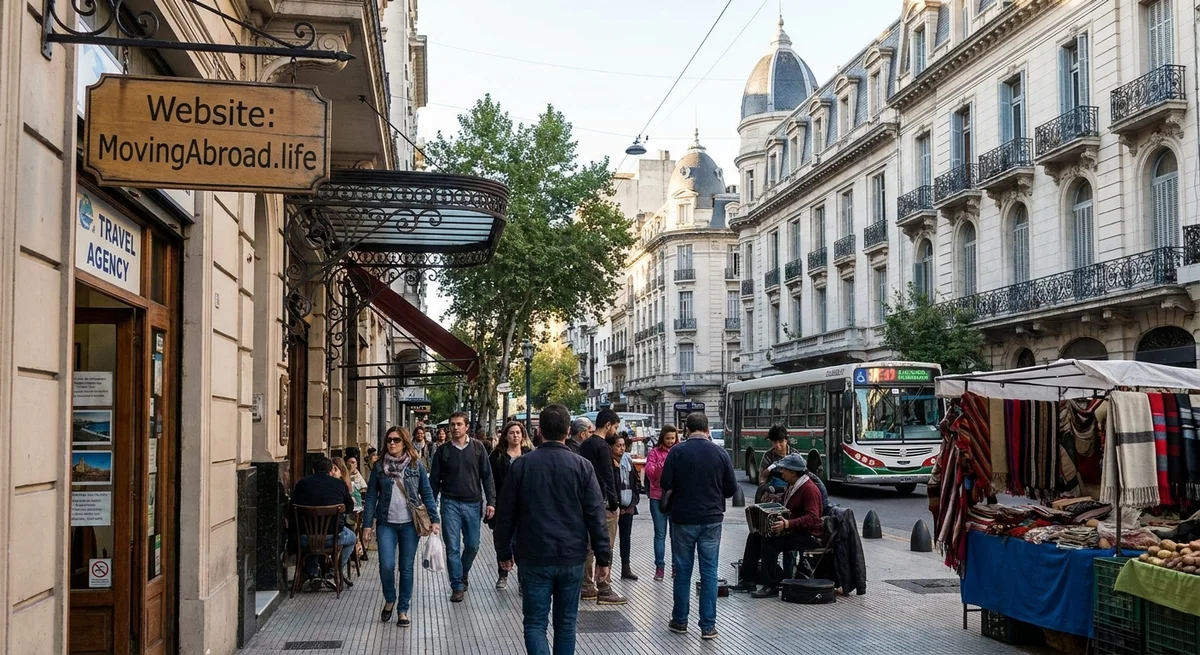
Buenos Aires, Argentina: European Flair, Latin Complexity
Buenos Aires: European Flair, Latin Complexity
Buenos Aires is South America’s largest city – a bustling metropolis of tree-lined boulevards and grand plazas evoking a distinctly European atmosphere. It’s famed for its tango, café culture, and high-quality beef – traits that have earned it nicknames like the “Paris of South America” (getwherenext.com). The city delivers world-class food, wine, tango and café life at a fraction of what a similar lifestyle would cost in Europe or North America (getwherenext.com) (getwherenext.com). But behind the charms lurk real challenges: Argentina’s chronically high inflation and complex currency controls affect everything from rent to daily budgets. In this guide we dive into the data on housing costs in key barrios (Palermo, Recoleta, Colegiales), how to budget amid volatile exchange rates, the latest visa pathways (including a city-backed nomad program and national digital nomad visa), the quality of private healthcare, tax rules for residents, and the practical sides of daily life (safety, transit, coworking, culture). We’ll also highlight some dealbreakers – like onerous currency controls, leases quoted in USD, and unpredictable bureaucracy – and briefly compare BA with alternatives like Montevideo and Santiago.
Cost of Living & Housing in Buenos Aires
Buenos Aires remains exceptionally affordable for foreign-currency earners, but locals and pesos-paid expats feel the squeeze from inflation. Rents vary dramatically by neighborhood and property. In trendy Palermo, a studio apartment (“monoambiente”) might run on average ARS 650,000–710,000/month (≈$800–900 USD at the official rate) and a one-bedroom ~ARS 840,000 (roomix.ai). In upscale Recoleta, similar studios average ~ARS 780,000 and 2-beds ~ARS 1,050,000 (roomix.ai). By contrast, semi-residential Colegiales can be cheaper: studios ~ARS 540,000 and 2-beds ~ARS 700,000 (roomix.ai). (For context, a “$1,000” USD rent would often work out to ~$1,400 after including building fees and utilities (buenosairesexpats.com).)
These ARS figures climb each month – Argentina’s inflation has exceeded 100–200% in recent years. Budget guides suggest a comfortable single-person lifestyle runs roughly $1,000–$1,800/month in Buenos Aires (getwherenext.com), far below European capitals but far above what local pesos earners manage. Families and expats should budget extra to stay ahead of inflation. For example, a modest 2-bedroom (around 50–60m²) in these neighborhoods today likely costs on the order of USD 400–700 (at market exchange) monthly, but lease figures are usually quoted in pesos or even in USD by landlords, creating uncertainty.
Exchange rate swings matter enormously. Argentina maintains multiple exchange rates: an “official” rate for some transactions and a higher “blue”/MEP rate for informal cash exchanges (nomados.ai). Under recent reforms, credit cards now usually convert charges closer to the more favorable MEP (financial) rate (nomados.ai), so tourists and nomads often benefit automatically on everyday spending. Cash can still be exchanged at informal “cuevas” for a better rate, but the huge 2022–23 gaps (80–100% or more) have narrowed (nomados.ai). In practice, expats say: use a no‐fee US credit/debit card (or fintech card) for most purchases; expect to pay more in peso prices than official estimates. Always budget in both AR$ and USD terms. In sum, BA offers value for those earning euros or dollars, but local prices adjust so that gains from currency arbitrage are not as outsized as a few years ago (nomados.ai) (nomados.ai).
Budget tip: Because landlords often quote rent in USD (buenosairesexpats.com), a prudent expat might calculate budgets in dollars and then convert at today’s market rate (not the official rate). For example, consider ARS 840,000 rent: at an official ~800 ARS/US$ that’s $1,050; at a blue rate ~2,000 ARS/$ it’d be $420. In reality you may pay somewhere in between. To be safe, work out budgets in USD with a buffer.
Neighborhood Budgets: Palermo, Recoleta, Colegiales
-
Palermo: The largest barrio, known for parks, cafes, plazas. There are sub-districts like Palermo Soho/Hollywood. In fresh market data (Apr 2026), a studio is ~ARS 650–710k, 1-bedroom ~ARS 840k (all per month) (roomix.ai). A furnished loft or 2-bed can reach ARS 1.2–1.5 million (especially in Palermo Soho). Monthly local utilities (electricity, gas, water, Internet) might add ~$60–100. Buenos AiresExpats notes that expensas (building fees) typically add 30–50% to the base rent (buenosairesexpats.com), so be sure to include that.
-
Recoleta: A leafy, historic area with grand architecture and luxury shops. Rents are among the highest outside Puerto Madero. For April 2026, average studio ~ARS 780k and 2-bed ~ARS 1,050k (roomix.ai). A nicer 2–3-bedroom apartment in Recoleta (often with balcony) runs from ARS 1.4 million upward (roomix.ai). This reflects high demand from wealthy locals and diplomats. Note: Recoleta’s expensas and utilities are also relatively high, so budget ~$1,500+ total (all in) for a modest 2-bed.
-
Colegiales: A quieter, more residential barrio just north of Palermo. Historically an “emerging” middle-class area, popular with young families. Rents are lower here. April 2026 figures: studio ~ARS 540k; 2-bed ~ARS 700k (roomix.ai). Even a 3-bed is under ARS 920k on average (roomix.ai). It’s not cheap by local standards, but Colegiales is often singled out as “Palermo-lite” with better value. If budget is tight, this or neighboring Belgrano/Villa Crespo might stretch your dollar further.
Mid-2026 Price Context: At an official rate of roughly 800 ARS/USD, ARS 700k ≈ $875. However, many expat-run budgets implicitly use the parallel market (on which $1 often buys 1,800–2,000 ARS). If planning in dollars, expect the cost in USD to fall somewhere between official and parallel rates, but always double-check the current spread when finalizing any deal.
Inflation and Exchange Volatility
Preparing a budget for BA must factor in inflation and currency risk. Argentina suffered >100% annual inflation rates in recent years, and the peso devalues constantly. The rapid inflation means a peso budget written today could be off by 20–30% or more in a year (getwherenext.com). Put another way, many expats budget in US dollars to hedge this risk. As WhereNext observes: a lifestyle that might cost $4,000–$5,000 in Europe can run only $1,000–$1,800 in BA (getwherenext.com) – a striking bargain if your income is in a stable currency.
Capital controls (“el cepo”) complicate matters. The government limits how many dollars individuals and foreigners can buy at the official rate. Originally, an “official” rate for tourists introduced an extra tax (the old “dólar solidario” at +75%), but recent reforms effectively unified tourist and savings rates (nomados.ai). On top of that, authorities have imposed quotas (for example, capping authorized monthly purchases at a few hundred dollars per person) and even instituted “90-day blocks” that force residents to wait 3 months before switching between official and financial dollar markets (www.batimes.com.ar) (nomados.ai). In plain English: you can’t simply withdraw or convert unlimited pesos to dollars at the price of your choice. Cash remains free-floating on the street market, but that’s technically illegal for foreigners.
For an expat, the upshot is:
- Use foreign-currency–based bank cards (Visa, MasterCard) which now bolt you onto the MEP/CCL rate (roughly the mid-market rate). Many nomads find no-foreign-transaction-fee cards effectively a “local rate” card (nomados.ai).
- Keep some US dollars cash in reserve (you can sometimes negotiate better rates in the “cuevas” or black market).
- Price groceries, eating out, groceries etc. in USD plus a cushion. Restaurants and shops will charge pesos, but if you can’t buy dollars at the official rate, you will effectively pay the parallel rate through inflation.
As one nomad guide summarizes: Buenos Aires is still excellent value in 2026, but you must “understand the basics” of the dual exchange rates (nomados.ai) (nomados.ai). Uruguay and Chile, by contrast, simply accept card payments at a single fair rate – no hidden blue-dollar complexity (nomados.ai).
Visa & Residency Pathways
Argentina has introduced several visa options for long-stay foreigners:
-
Buenos Aires Digital Nomads BA (city program): This is an initiative by the city government (through InvestBA) to attract remote workers, not a legal visa per se. Launched in 2020, the “Nómades Digitales BA” program boasts tens of thousands of sign-ups (78,000 by 2023 (buenosaires.gob.ar)) and conferences inviting nomads from the US, Spain, Germany, etc. It entitles participants to certain support (co-working events, networking) and publicity but doesn’t grant immigration status itself (buenosaires.gob.ar). You still need a formal visa to stay legally.
-
National Digital Nomad Visa (Residencia Transitoria): Argentina’s federal government now offers a “Residencia Transitoria para Nómadas Digitales”. In practice, this functions like a special remote-work residency. It was officially launched in 2022 and expanded by decree in 2025 (www.lucerolegal.org). The visa is initially valid for 1 year (180 days plus a 180-day extension) and can be renewed up to a total of 36 months (www.lucerolegal.org). Requirements include proof of remote work (contract or clients outside Argentina), stable income (around ~$2,500/month historically) (www.lucerolegal.org), a valid health insurance, and a clear criminal record. Applications are submitted online. Notably, this visa allows holders to work for foreign companies but not for Argentine employers (getwherenext.com).
- Tax note: The Digital Nomad Visa is structured so that you are taxed only on Argentine-sourced income (getwherenext.com). In practice, if you earn entirely from abroad while on this visa, your Argentine tax liability is effectively zero (getwherenext.com) (getwherenext.com). This is a major perk for remote workers. (By contrast, full tax residency in Argentina—generally triggered by 12+ months living there—would tax your worldwide income up to 35% (getwherenext.com) and even levy a personal asset tax on net foreign assets (getwherenext.com).)
-
Tourist Visa Extension: Many nomads start on the standard 90-day entry (Argentina allows 90 days visa-free for many nationalities), then extend it once (another 90 days) by a process with Migraciones. This is free and relatively quick, but it technically is not meant for work. Officially, if you stay longer or continue working remotely, you should switch to a temporary residency. Still, nomads often use 90+90 as a stopgap (with the caveat that it could be seen as legal gray area for working).
-
Rentista / Pensionado (Retiree) Visas: These are longer-term visas for those with stable foreign income. The pensionado visa requires proof of a retirement/pension income of at least 5× Argentina’s minimum wage (about US$2,000+ per month) (www.argentina.gob.ar). The rentista (or “job letter” visa) historically required a fixed contract or proof of self-employment income (around the same threshold). They grant 1–2 years residency (renewable). These visas let you bring family and work remotely too. Once granted, imposes no local income requirements aside from the initial proof. (In mid-2024 Argentina updated visa law, but as of 2026 the basics remain: a pensionado visa notably has a $ requirement (www.argentina.gob.ar).)
-
Permanent Residency / Citizenship: After a few years (often living on a temporary visa and demonstrating integration), one can seek permanent residency. However, this path was traditionally more bureaucratic and often demanded a sustained economic activity or investment.
Key point: While on the Digital Nomad or Rentista visa, only Argentine-generated income is taxed locally (getwherenext.com). Many expat guides counsel that if your only income is from abroad, staying on these temporary schemes can legally keep your tax bill to zero in Argentina (getwherenext.com). Only when/if you take out Argentine work or exceed the visa term would you face full tax residency rules (which can include up to 35% on world income and 0.5–1.75% asset tax) (getwherenext.com) (getwherenext.com).
Private Healthcare Quality
Argentina’s healthcare system is a mix of free public hospitals and a large private sector. Public hospitals (obras sociales, municipal hospitals) have traditionally offered free or nominal-cost care to everyone (even tourists) (expatarrivals.com). Wait times can be long, however, and services can be uneven. The system faces occasional budget cuts and a recent government proposal would charge non-residents for some services (expatarrivals.com). Most expats avoid relying solely on public care for anything serious.
By contrast, private healthcare in Buenos Aires is excellent. The city boasts dozens of high-standard clinics – many affiliated with national universities or foreign communities (German Hospital – Hospital Alemán, Hospital Italiano, British Hospital, maternal-child Pajaut Medicine Center, etc.) and highly trained physicians (often bilingual). Medical tourism is common: Americans and Europeans flock to BA for procedures (dental, vision, cosmetic surgery) at a fraction of Western prices (expatarrivals.com). Private health prepagas (insurance) cost as little as USD 50–150 per month for a comprehensive plan (getwherenext.com), giving access to top-tier hospitals. For perspective, WhereNext reports that even the best private plans run roughly $50–150/month there (getwherenext.com) – a level that covers consultations, some tests, and reasonable discounts on major procedures.
Private health care is thus very good quality and significantly cheaper than in the U.S./Europe (expatarrivals.com). Expats frequently praise BA’s modern facilities and English-speaking staff. If you plan to stay long-term, factoring in a private insurance (“obra social” sign-up or prepaid plan) is wise. Even better, short-stay visitors can often pay for services out-of-pocket at rates that remain low for foreign currency holders. A routine doctor’s visit in a private clinic might cost a few dollars worth (in pesos), whereas hospital stays or surgery can still be 70–80% cheaper than in North America.
Taxes & Finances
Argentina’s tax system can be daunting. In brief: Residents are taxed on worldwide income, with marginal rates up to 35% (getwherenext.com). There is also a personal assets tax (Impuesto sobre los Bienes Personales) of 0.5–1.75% on net global assets above about $300,000 (getwherenext.com) – a rare burden that catches many wealthy expats. These taxes apply once you become an Argentine tax resident (generally triggered by 12 months of physical presence or “center of vital interests”).
However, for many expats this isn’t immediate. As noted above, the Digital Nomad Visa deliberately avoids creating tax residency (getwherenext.com). Official guidance and expat lawyers point out that if you are on that visa and earn only from abroad, “your tax obligation to Argentina is effectively zero” (getwherenext.com). Likewise, short tourist visitors pay no Argentine income tax (since tourist visas don’t require local employment). Only if you switch to permanent residency, start a local job, or explicitly transfer capital here do you fall under full tax rules.
One more twist: Argentina imposes a 21% VAT on most goods and services (hidden in prices), but certain bills (rent on principal residence, schools, some utilities) are exempt. There is no capital gains tax on most consumer assets, but financial positive yields (stocks, bonds) can face 15%. Expats often aren’t deeply impacted beyond the big global tax issues above. One caution: if you invest or buy property, ask a local adviser – taxes on property, inheritance, or foreign currency transactions can have special rules.
Takeaway: The big tax story is resident ⇒ tax on world income. Many digital nomads happily avoid this by staying “non-resident” under the nomad visa or short-stay schemes (getwherenext.com) (getwherenext.com). But plan carefully: if you do choose full residency, be aware of the progressive 35% rates and asset taxes (getwherenext.com) (getwherenext.com).
Safety, Transit, and Daily Life
Safety: Buenos Aires is generally safe by Latin-American standards, certainly more so than capitals like Rio or Bogotá (getwherenext.com). The city’s homicide rate is low (around 5 per 100,000 inhabitants (getwherenext.com)) – comparable to many European cities. In fact, a recent analysis notes Buenos Aires often ranks as the safest major city in the Americas (Global Peace Index rank #47 worldwide, #1 in South America (www.bloomberglinea.com)). The US State Department currently gives Argentina a Level 1 advisory (“exercise normal precautions”) – same as Canada or Japan (travel.state.gov).
But petty crime is common. Pickpocketing, bag-snatching (often by teenagers or motorbike thieves called “motochorros”), and fraudulent street scams happen frequently. Expats recommend caution: don’t flash phones or wallets in public, especially at transit hubs or in crowded areas. Stick to main streets at night, and avoid known “no-go” zones like beyond the Caminito in La Boca. Notably, the safest neighborhoods are in the north (Palermo, Recoleta, Belgrano) where police presence is high; the south can be sketchier after dark. Doors in office buildings often remain unlocked with 24/7 reception, taxi apps are widely used, and many residents carry anti-theft bags. Overall, violent crime against foreigners is rare, and most risks are non-violent theft. Vigilance and simple precautions (daylight taxis/Uber, not leaving valuables in sight) keep most visitors trouble-free.
Transportation: Buenos Aires has a complex but functional transit system. Its colectivo buses have nearly 150 routes covering the city; fares are low (around ARS 100 with a SUBE card). In 2026, many buses now accept contactless card (Visa/Mastercard) tap payment (nomadicsean.com), though most locals still use the rechargeable SUBE card. The Subte (underground metro) has 6 lines linking key barrios – coverage is decent but lines can be crowded at rush hour. It’s generally safe during the day (especially lines D, C, H through north neighborhoods) but some stations near Retiro/Constitución or in the south advise caution after dark (nomadicsean.com). Commuter trains stretch far into the suburbs; again, mostly safe if you’re in carriage with others and use them in daylight.
Taxis and rideshares: Uber and Cabify operate legally and are recommended for convenience and safety, especially at night. They typically cost a few dollars for short rides. Licensing issues mean you should avoid hailing random street taxis (even if yellow) – some have rigged meters. If you do use one, insist on the official price book or use radio taxis. In practice, many expats never ride non-app cabs. For a quick rule: use Uber/Cabify by default; SUBE buses/Subte by day; avoid late-night commuting except via trusted rides.
Coworking & Community: Buenos Aires has a vibrant digital-nomad scene. There are dozens of coworking spaces, especially in Palermo and Microcentro. Notable examples: AreaTres (Palermo) offers fixed desks and tech networking for roughly $120/month (www.lucerolegal.org); Coffice (Villa Crespo) is a hybrid café/coworking for about $60/month (www.lucerolegal.org); and Ballena Cowork in Chacarita (~$75/month) features creative events and an outdoor patio (www.lucerolegal.org). WeWork and similar international chains also have locations (starting ~$150/month). Monthly coworking memberships thus range ~$50–150 at mid-level spaces. The nomad community is sizable – Meetups, Slack groups, and the annual Nomads BA Conference (sponsored by the city) keep people connected. Internet is reliably fast (fiber to home available in good areas, typical speeds 50–200 Mbps) and Wi-Fi is ubiquitous in cafés and plazas. Buenos Aires’s timezone (GMT–3) is convenient for working with clients in Europe or North America.
Culture & Lifestyle: BA’s cultural life is unparalleled in the region. Dozens of theatres (the iconic Teatro Colón opera house, the Sofovich chain of cinemas, free cultural centers) host live performances nightly. Tango music and dance can be sampled in milongas across the city. The café/bar culture is ingrained – expect locals lingering over cortados at any coffee shop until late. Foodies and wine-lovers rave about the quality and price of Argentine beef, Malbec, and Italian/Spanish-influenced cuisines (pastas, empanadas, parrillas). Outdoor life revolves around parks like the sprawling Bosques de Palermo or cultural squares like Plaza Serrano in Palermo, Plaza Francia in Recoleta, and the riverfront promenade (Puerto Madero). Weekend street markets (San Telmo, Mataderos) offer crafts and folk music.
In short, the city lives up to its hype: “world-class food, wine, tango, café culture – the ‘Paris of South America’” (getwherenext.com). Much of downtown and the northern barrios feels very European; beaches and mountains are nearby for weekend escapes. Argentine Spanish is generally clear (much like Italian or neutral Latin American), and many catalogs/services have some English support – though learning basic Spanish will greatly ease daily life.
Dealbreakers & Cautions
Despite its appeal, Buenos Aires has some dealbreakers for the unwary:
-
Capital Controls: As mentioned, the government heavily restricts foreign currency access. Tourists and new residents can buy only small fixed-dollar amounts each month at the official rate (in effect, raising the price with taxes). There are ever-changing rules on currency flows. This can frustrate newcomers who need to remit large Phoenix or handle investments. If you’re very risk-averse or need easy dollar access, the cepo may be intolerable. (By contrast, Uruguay and Chile have no similar controls – you can use credit cards freely at market rates (nomados.ai).)
-
USD-Leased Contracts: Many landlords insist on nominal USD rents (often referencing an exchange rate clause). Although under law rental contracts were supposed to be in pesos after late-2023 reforms, enforcement is unclear. Paying in USD may sound convenient, but if you don’t actually have dollars and your income is in pesos or another currency, it can be grim. At the very least, count on needing a large security deposit (often 2–3 months’ rent) and/or a “garante” (lender guarantee) to secure an apartment (buenosairesexpats.com). The uncertainty over which currency will actually be charged (locals often haggle to ARS entries “at Banco Nación price”) is a headache.
-
Unpredictable Paperwork: Argentine bureaucracy is famously slow and capricious (getwherenext.com). Expect visa appointments, immigration paperwork, or getting a local ID (DNI) to take months and require many documents. Processes can change abruptly based on new decrees. Even utility hookups or phone lines sometimes need a domicilio letter and multiple forms of ID. An oft-cited warning: “Obtaining a simple identification card can involve months of appointments, photocopies, and waiting” (getwherenext.com). If you plan to stay long-term, allocate extra time (and possibly a fixer or lawyer) for all legal registrations – anything from opening a bank account to importing goods can involve red tape. By comparison, Uruguay and Chile may still have bureaucracy, but their processes have fewer currency/legal cross-currents.
-
Inflation Shock: Annual inflation can jump your bills significantly within a year. Tenants often must renegotiate rents yearly. Salaries and pensions lose purchasing power rapidly. If your income fluctuates or is not indexed, your budget could be blindsided. Expats should be vigilant about adjusting budgets every few months, especially as government policies on subsidies and import tariffs change frequently.
-
Utility Quality: While electrical and water systems are generally reliable, occasional power outages can occur (mostly in summer peak). Internet and cable TV are good in the city, but service outages or slower speeds may happen if lines are congested. Keep backup power banks or a small UPS for essentials (and a bottled water supply if needed).
Montevideo and Santiago: Other Options
For perspective, compare BA with two nearby capitals — Montevideo, Uruguay and Santiago, Chile — that many expats consider:
-
Safety & Stability: Montevideo is consistently ranked safer than BA, with friendly police and very low violent crime. Chile is also relatively safe by Latin standards (though petty theft exists). Argentina’s Liberal-conservative junta.
-
Economic Environment: Uruguay and Chile both use freely floating currencies (URU peso, CLP) and have no fierce dual-rate markets. Montevideo’s cost of living is higher: one cost survey finds BA about 28% cheaper than Montevideo (www.expatistan.com). Another source shows a typical monthly BA budget ~$1,412 vs ~$1,632 in Montevideo (citycost.org). In practice, small goods (groceries, transport) are often pricier in Uruguay. Santiago’s cost can be similar to or slightly below BA for some items (citycost.org), but housing is expensive in USD terms (1-bedroom rents in Santiago city center often exceed those in BA once converted). (Note: these comparisons use general averages; personal spending patterns vary).
-
Visas: Both Uruguay and Chile have responded to the nomad trend. Uruguay launched a digital-nomad residency permit in 2023 – a 6-month (renewable) visa for remote workers (www.uruguayxxi.gub.uy). Chile introduced a “Remote Work Visa” in late 2023 (pend on final rules), offering up to 1–2 years for foreign-contract workers with no official income minimum (www.expat.com) (www.expat.com). However, neither country’s visa policies involve exchange-rate quirks like Argentina’s.
-
Healthcare: Private healthcare quality is excellent in both: Chile’s top clinics and Uruguay’s are comparable to Argentina’s, but costs are higher (closer to U.S. prices). Many expats in Uruguay or Chile still opt for private plans or pay high fees, whereas in BA foreign currency can stretch further on medical services.
-
Culture & Community: BA’s cultural scene is richer by far – vast theatre offerings, nightlife, and expat networks. Montevideo is quieter (more beach-town vibe) and Santiago more businesslike and spread-out (with better mountain and beach access, but with commuting traffic). BA is known for nightlife lasting until dawn, while Montevideo can feel sleepy. You’ll find fewer international colleagues in Uruguay/Chile simply because their economies are smaller.
The bottom line: If predictability and ease are your priorities, Montevideo or Santiago might appeal more. Uruguay’s stable economy and Chile’s solid institutions mean no currency controls, simpler legal processes, and transparent pricing. But you will pay more overall and miss some of Buenos Aires’s urban vitality. Buenos Aires, by contrast, offers extraordinary day-to-day affordability (for USD earners) and a rich cultural life (getwherenext.com) (getwherenext.com) – at the cost of economic ups-and-downs and bureaucratic puzzles.
Conclusion
Buenos Aires dazzles with its European-style beauty and vibrant culture, offering expats an irresistible value proposition if they can navigate its complexities (getwherenext.com) (getwherenext.com). Modern nomads can leverage new visa options, affordable healthcare, and a robust coworking scene to settle here. But anyone moving must budget carefully, stay informed about money rules, and maintain a healthy dose of flexibility. In the end, Argentina rewards those who weigh the quirks — from capital controls to USD leases and bureaucracy — against the charm of living cheaply in the city’s historic cafes and plazas. As one analyst puts it, Argentina can give you “a First World lifestyle at developing-world prices” (getwherenext.com), but “the country is not one you move to casually” due to its volatility (getwherenext.com). By doing the research (like we’ve done here) and planning for the twists, remote workers and expats can decide with confidence whether Buenos Aires’ Latin complexity is the right adventure for them.
Get New Relocation Research & Podcast Episodes
Subscribe to receive new research updates and podcast episodes about moving abroad, best places to live, expat life, remote work destinations, retirement abroad, cost of living, visas, safety, healthcare, and quality of life.